Will AI replace recruiters?
No. AI takes over sourcing, screening and candidate updates. Recruiters keep the judgment on what a role needs, who fits it and how to close the hire.
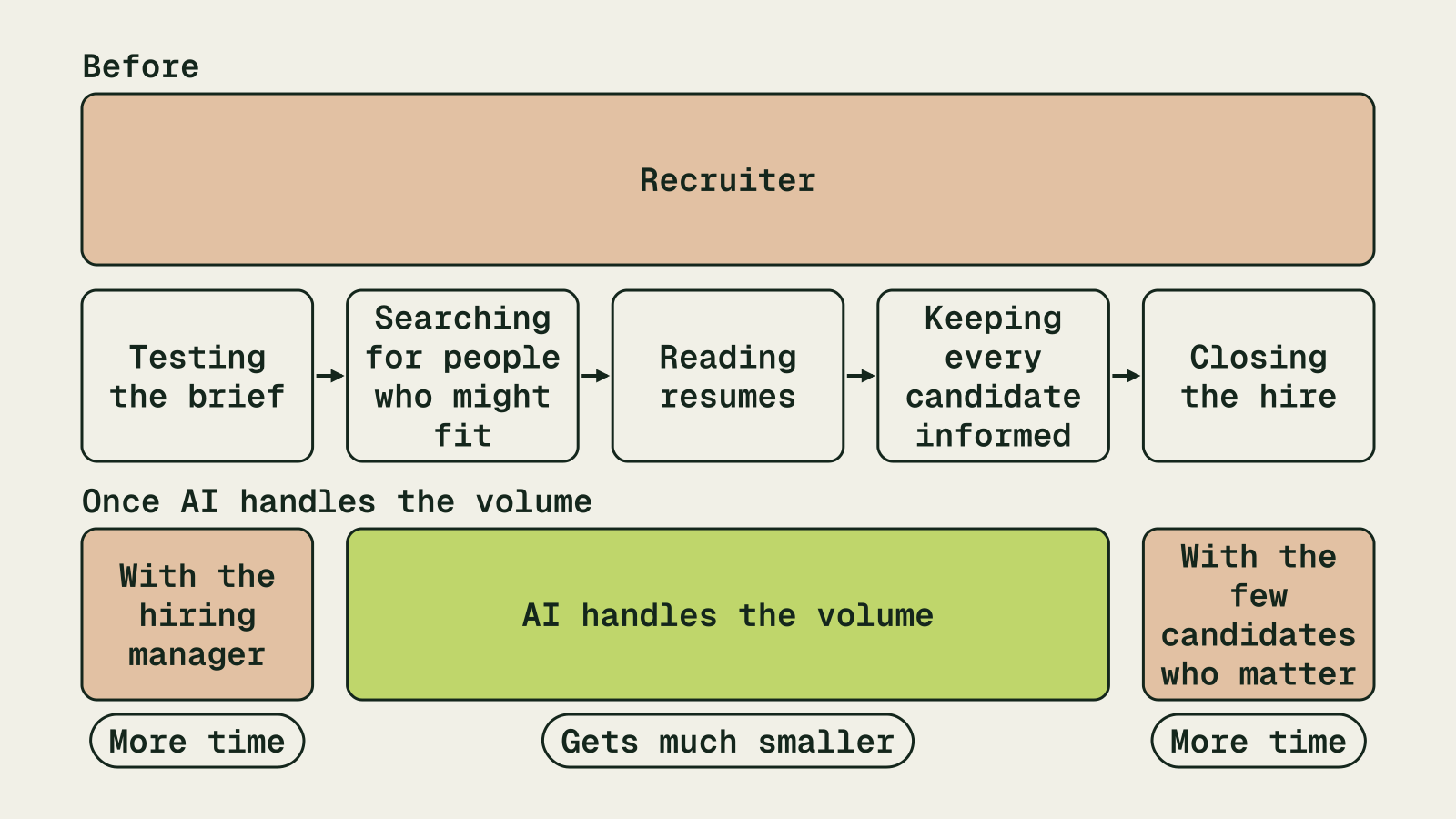
No. AI is taking over the volume work in recruiting: searching for people who might fit, reading through inbound resumes and keeping every candidate informed as a search moves. What stays with recruiters is the judgment that makes a hire work: working out what the role really needs, reading the candidates who don't match a template, and convincing the right person to say yes.
What part of recruiting can AI already do?
The volume work. A typical search spends its time on routine work: looking for people who might fit, writing first messages, reading a pile of resumes against a job description, answering the same questions about the role and logging every step. Each of those tasks repeats from one search to the next, and each ends in something a person can check: a shortlist, a reply, an up-to-date record.
That is the kind of work that moves to systems first, as we set out in When should you not use AI agents? A system can write tailored outreach for hundreds of people, sort a stack of resumes by the criteria it was given, and tell each candidate where they stand at any hour.
If that were the whole job, recruiters would have a problem. It isn't.
Why is a hire a judgment call on both sides?
Because a hire is a match two parties have to agree to, and often neither side knows exactly what it wants when the search begins. Three moments show where the judgment sits:
- The brief is off. The hiring manager asks for a title and a list of skills, but the real gap is something else: a team that needs someone who can lead people, not just do the work, or a role that becomes far easier to fill once one requirement is dropped. Catching that early changes the whole search.
- The candidate doesn't fit the pattern. A career change, a gap, or a small company where the job was much bigger than the title. Sorting by the job description pushes these people down the list. A recruiter who reads the story behind the resume can bring them back.
- The candidate isn't sure. The strongest person is often not looking. Finding out what would make them move, and whether this role offers it, takes a real conversation, not a sequence of messages.
In each case, the recruiter is weighing things no job description spells out. A ranked shortlist feeds that weighing. It doesn't do it.
Where does a recruiter's time go once AI handles the volume?
To the two ends of the search. At the start, recruiters spend more time with the hiring manager, testing the brief against what the team needs and against who is realistically available. At the end, they spend more time with the few candidates who matter: learning what drives them, handling a counteroffer, and keeping a finalist engaged while the company takes its time to decide.
The middle, where much of the time used to go, gets much smaller. It is the same shift we described in Will AI replace accountants? and Will AI replace medical coders?: the first pass moves to a system, and people move to the calls around it.
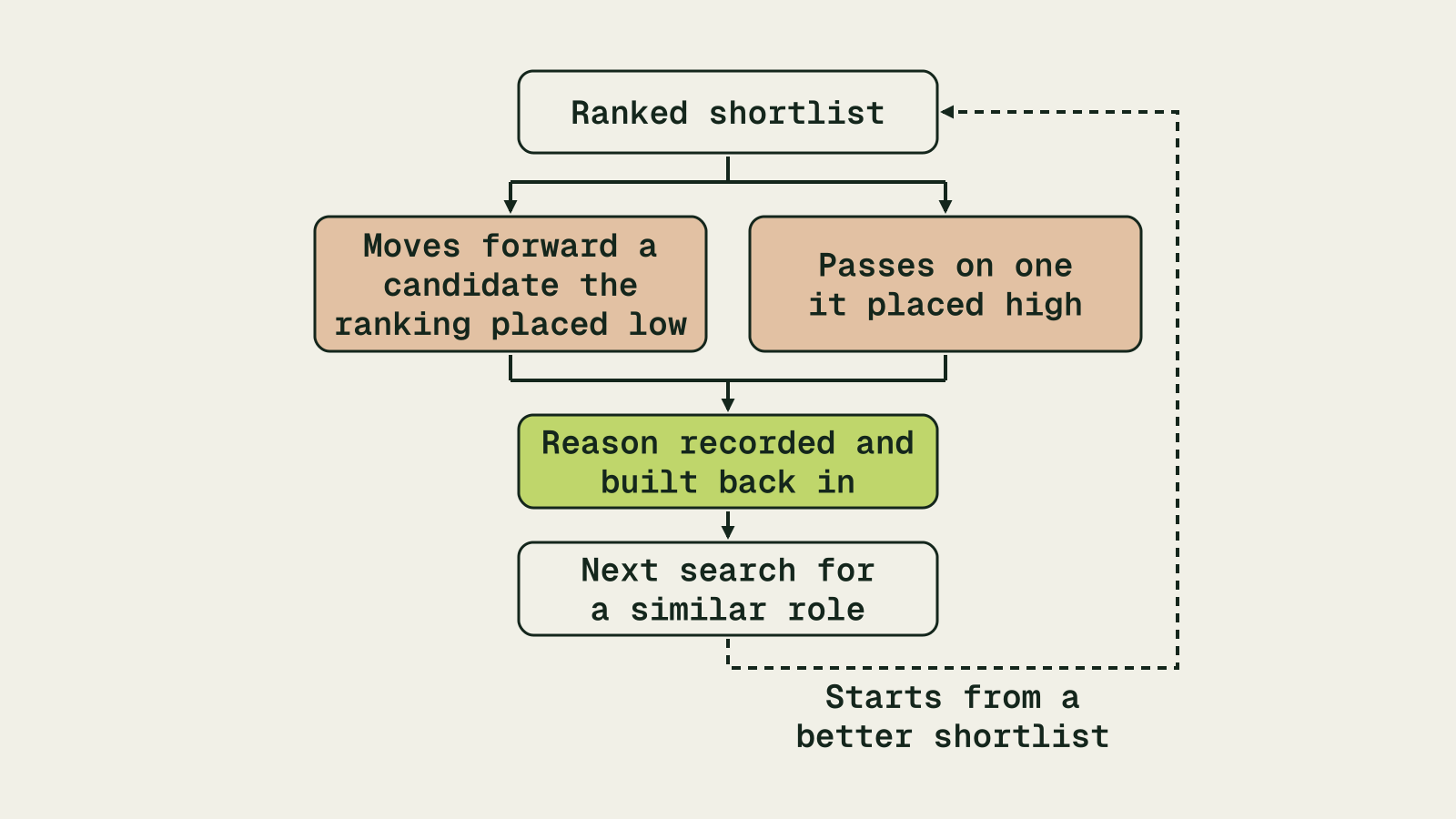
In a business built around AI, those calls also teach the system. When a recruiter moves forward a candidate the ranking placed low, or passes on one it placed high, the reason can be recorded and built back in, so the next search for a similar role starts from a better shortlist. We explain that loop in How does a data flywheel make each job cheaper in AI-native services?
What should companies that buy recruiting pay for?
Finished hires, not search activity. Outside recruiters are often paid only when someone is placed, with the fee linked to the new hire's pay. Once AI makes the search itself cheap, a stack of resumes is worth very little. What a buyer is really paying for is the judgment: the brief that was right, the candidate others overlooked, the offer that closed.
Useful questions for any outside firm or in-house team:
- How much of each search runs on systems, and at which points does a person step in?
- Who tests the brief with the hiring manager before the search starts?
- How are candidates the ranking placed low reviewed, and how often are they moved forward?
- Does each search make the next one faster, and can you show it?
- Is the price tied to a finished hire, or to effort? We cover why that matters in What is outcome-based pricing?
How do we approach this?
In our companies, each job is split into the steps a system can run and the decisions that need a person. AI executes the routine. Specialists own the judgment. Applied to recruiting, that would mean the system finds, sorts and keeps people updated, while specialists shape the brief, read the candidates who don't fit a pattern, and close the hire.
Each of those decisions would be captured with its reason. Over time, more of each search's routine would run on systems, and specialists would spend their hours where a hire is won or lost. That is how the cost of each job keeps falling, rather than dropping once and then staying flat.
Questions people ask
Will AI replace recruiting firms and headhunters?
A shortlist on its own is worth little now that a system can produce one cheaply. Firms that bring judgment about the role, reach people who aren't looking and know how to close are the ones likely to keep their place, and are more likely to be paid for the hire than for the search.
Can AI screen candidates without a recruiter?
It can sort candidates against the criteria it is given, and for high-volume roles it can prepare much of the first screen. A ranking only reflects those criteria, though, so a person decides who moves forward, looking closely at the candidates near the cutoff and the ones whose background doesn't follow a familiar path.
Will AI replace in-house recruiters?
In-house teams are likely to need fewer people on searching and coordination. The recruiters who remain spend more of their week with hiring managers and finalists, so the job shifts from moving each opening through its steps to getting the hire right.
What is AI in recruitment?
It means handing the repeat work of hiring to systems: finding possible candidates, reading resumes, drafting messages and keeping records current. People still decide what the role needs, who moves forward and who receives an offer.
Questions or ideas? Email hello@skywakelabs.com.
Buyers, investors and partners: hello@skywakelabs.com
More notes
What is agentic BPO?
Outsourcing where AI agents work most cases and specialists take the exceptions. Real agentic BPO prices the finished case, not seats or agents.
ReadWill AI replace procurement teams?
Not the team. AI takes the paperwork of buying; people keep the decisions with no written answer: which supplier, on what terms and whether to buy at all.
Read