Will AI replace procurement teams?
Not the team. AI takes the paperwork of buying; people keep the decisions with no written answer: which supplier, on what terms and whether to buy at all.
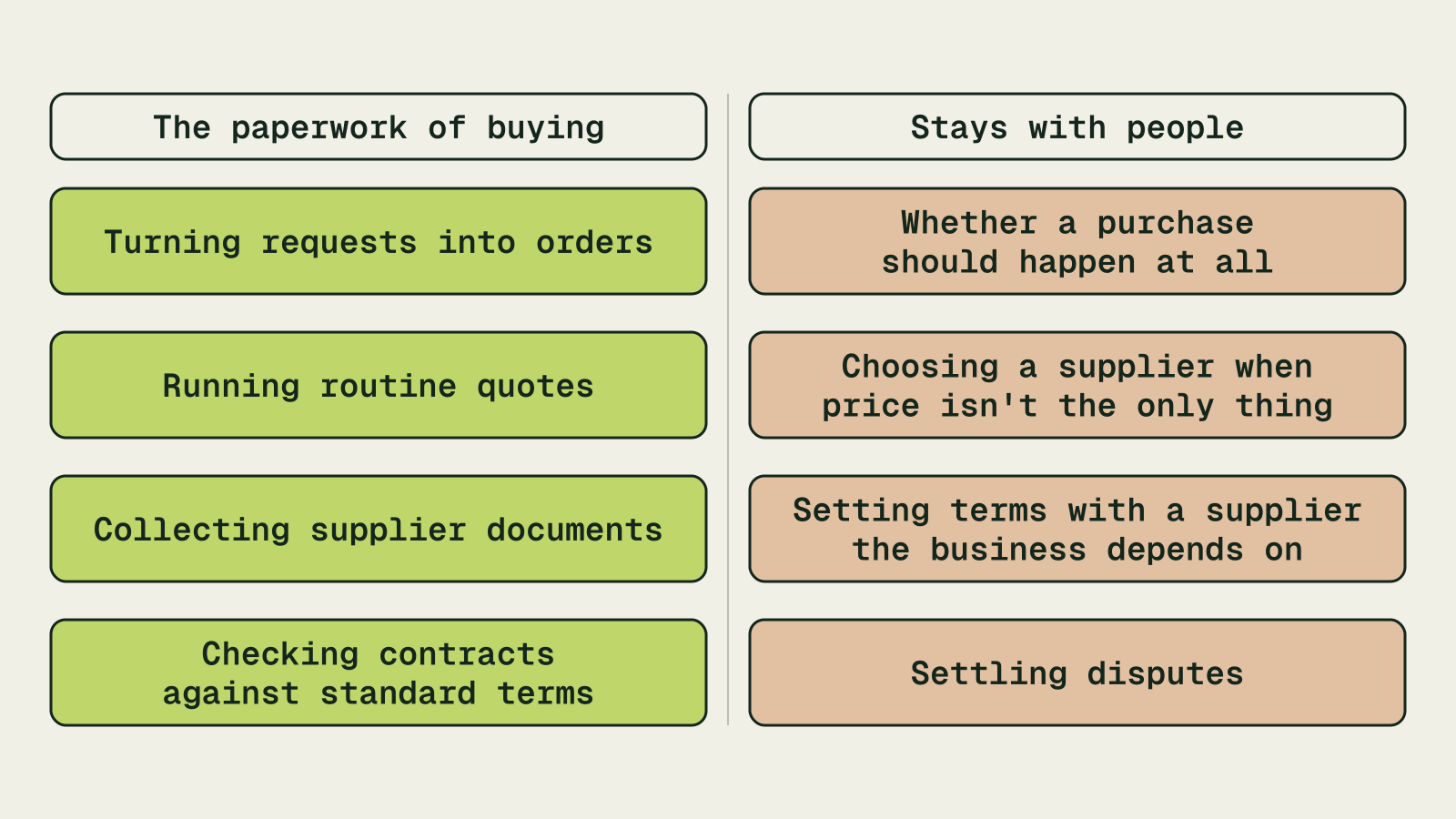
Not the team, but much of what fills its week. AI is taking over the paperwork of buying: turning requests into orders, running routine quotes, collecting supplier documents and checking contracts against standard terms. What stays with people is every buying decision whose right answer isn't already written down, and the job of writing those answers down so the next purchase needs less of a person's time.
What fills a procurement team's week today?
Much of a procurement team's time goes not on negotiation but on the work around each purchase:
- reading requests that arrive as emails, forms and chat messages, and working out what the person actually needs
- finding the right supplier, contract or catalog item for each one
- sending out quotes for routine buys and comparing what comes back
- chasing new suppliers for tax forms, insurance certificates and bank details
- checking contract drafts against the business's standard terms
- answering "where is my order?" and keeping records current
All of it repeats, and each result can be checked against a request, a contract or a set of terms. A system can read a messy request, match it to an existing contract, gather the supplier's documents and flag clauses that differ from standard.
The rest of the week is heavier: deciding whether a purchase should happen at all, choosing between suppliers when price isn't the only thing that matters, setting terms with a supplier the business depends on, and settling disputes. That part doesn't shrink with the paperwork. In our view, it becomes the core of the job.
Which purchases can AI run from request to order?
The useful test is not how much a purchase costs. It is whether the right answer already exists somewhere in writing. A purchase can run from request to order without a person when:
- the supplier is already approved,
- the item and its price are already agreed in a contract or catalog, and
- the result can be checked: the order matches the terms and the goods or service arrive as ordered.
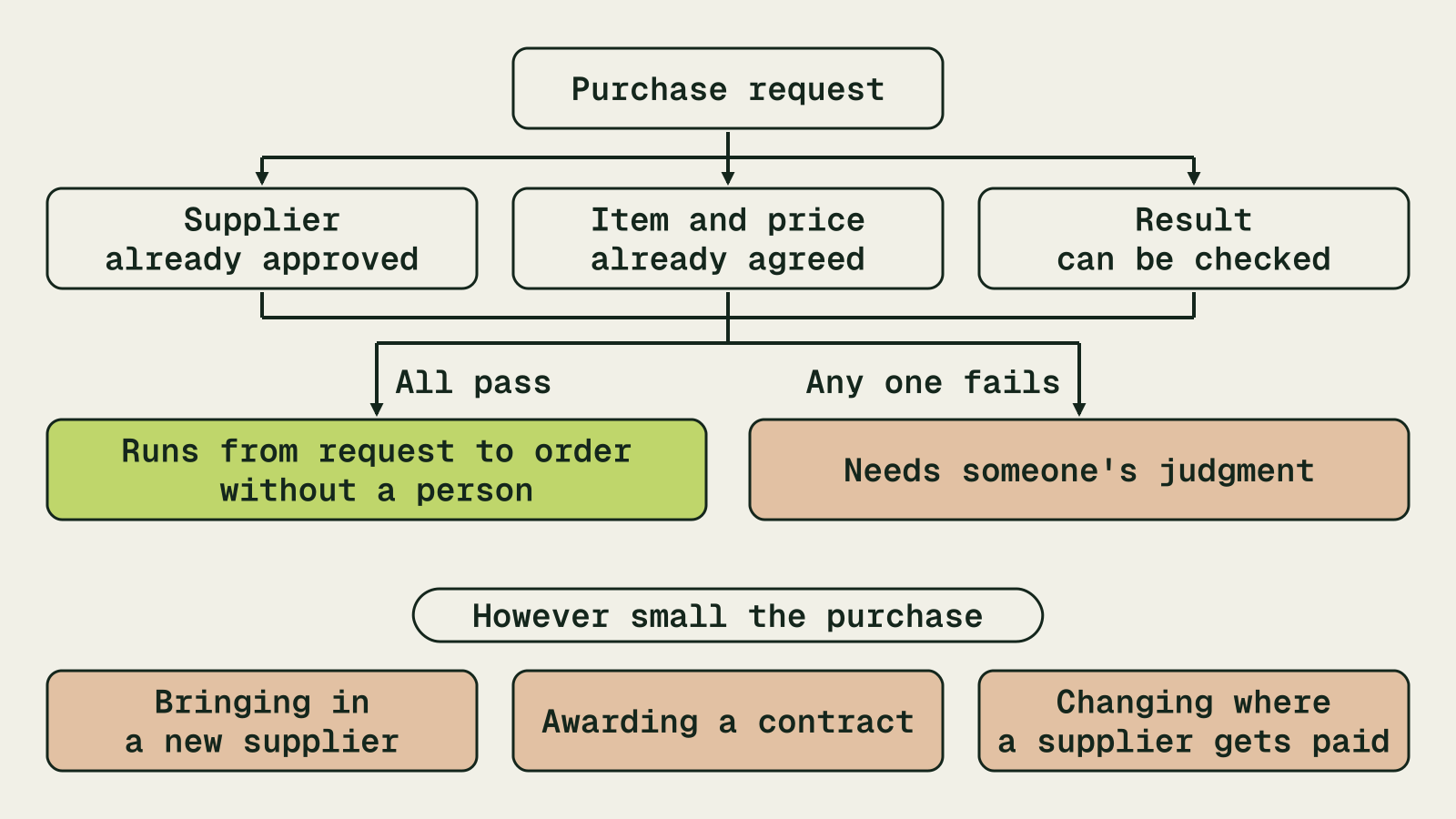
When all three hold, a person adds little by touching the order. When any one fails, the purchase needs someone's judgment, even for a small amount: a first order from a new supplier, an item nobody has bought before, a term the contract doesn't cover.
Some steps fail the test by their nature, however small the purchase: bringing in a new supplier, awarding a contract, changing where a supplier gets paid. Each one sets up something that isn't written down yet. We cover why bank detail changes need two people in Can AI take over accounts payable?, and the general test for when an agent doesn't belong in When should you not use AI agents?.
What does the team do when suppliers use AI too?
Some suppliers already use AI to answer quotes and work through routine negotiations. When both sides have a system that can trade messages around the clock, the back-and-forth on a routine renewal stops being where the value is.
What matters is what each system has been told to accept. Someone has to decide in advance what each system may agree to on the business's behalf, and what it must bring back to a person. Setting those limits well is a judgment about the business's needs, its other options and how much it relies on the supplier. A system can work inside its limits. It can't tell you whether the limits are right.
So the team's role moves upstream: less time running each negotiation, more time setting its limits and checking where those limits were wrong.
Why does the reason behind each decision matter more than the decision?
Procurement teams usually record what they decided: which supplier won, at what price. The reason is often left out. The reason the team chose the second-cheapest supplier, accepted a longer delivery time or refused a clause usually lives in an email thread or in one person's head.
That gap decides how far AI can go. A system can only reuse a judgment it can see. When each award, exception and refusal is captured with its reason, the next similar request can start from that reasoning instead of from scratch. Over time, purchases that once needed a person meet the three checks above, because the answer is now written down.
This is the same loop we describe in How does a data flywheel make each job cheaper in AI-native services?, used in buying.
Where should a procurement leader start?
Start where the answers are already written down, and build outward from there.
- Routine buys from approved suppliers. Catalog items and contract renewals on known terms are the first work to hand to a system. They are numerous and checkable, and they rarely get a person's full attention today.
- Supplier documents. Collecting and checking forms and certificates is slow work with clear rules. It is a good place to see how the system handles gaps and follow-ups.
- Last, the decisions. Supplier choices and key negotiations stay with the team. What changes is that each one is recorded with its reason, so it can inform the next.
In our companies, AI executes the routine. Specialists own the judgment calls, and every judgment is captured and built back in. The aim is not a smaller team for its own sake, but one whose time goes on the decisions that still need it while the cost of each finished purchase keeps falling.
Questions people ask
Will AI replace procurement jobs?
In our view, AI will take over much of the transactional work, such as raising orders, chasing supplier documents and running routine quotes. Roles built on that work will shrink or change, while roles built on supplier choices, terms and disputes become a larger share of the job.
Can AI negotiate with suppliers?
Yes, within limits a person sets. AI can run routine negotiations such as renewals and standard quotes inside a set price range and set terms. Negotiations with suppliers the business depends on, or with terms nobody has agreed before, still need a person.
What is an AI procurement agent?
It is a system that carries out procurement steps on its own, such as reading a request, finding the right supplier or contract, drafting an order or quote request and following up. It works inside rules the procurement team sets and hands anything outside them to a person.
What is tail spend, and why does it suit AI?
It is the stream of small, occasional buys that sit outside the main contracts. Each one is minor, but together they make up much of a team's order volume. It is a good fit for AI because each purchase is simple and checkable, and few teams have time to manage it closely.
Questions or ideas? Email hello@skywakelabs.com.
Buyers, investors and partners: hello@skywakelabs.com
More notes
What is agentic BPO?
Outsourcing where AI agents work most cases and specialists take the exceptions. Real agentic BPO prices the finished case, not seats or agents.
ReadAI agents vs RPA: what's the difference?
RPA repeats a fixed script and stops when a case doesn't fit; an AI agent reads each case and works out how to handle it. The real gap is in the exceptions.
Read