When should you not use AI agents?
Skip AI agents when the work has no checkable result, rarely repeats, runs on fixed rules or is mostly judgment. Use them on routine steps you can check.
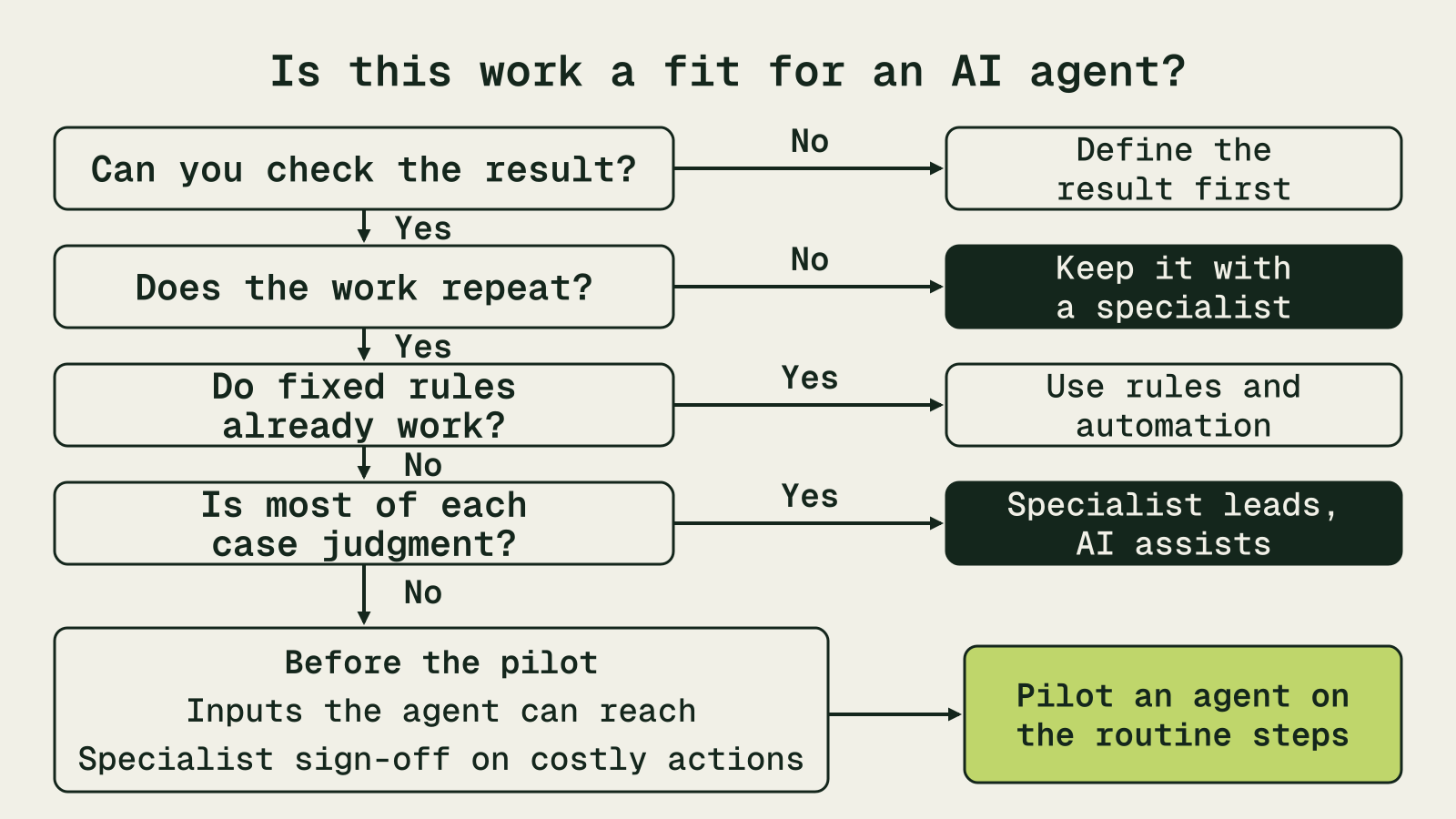
Don't use an AI agent when you can't say what a correct, finished result looks like, when the work rarely repeats, when fixed rules already do the job, or when nearly every case turns on judgment. Agents earn their place on work that repeats at volume and has a result you can check, where they run the routine steps and the hard cases go to a specialist.
Why is "can an agent do this?" the wrong question?
Because an agent will attempt almost anything you hand it. It will read the documents, work through the systems it can reach and produce a confident answer. A demo on hand-picked cases can make nearly any workload look ready.
The better question is whether the work suits an agent, and what it costs when the agent is wrong. That is a question about the workload, not the model. It is also a different question from which individual decisions need a person, which we cover in Human in the loop vs human on the loop. Here the question comes one step earlier: should an agent be on this work at all?
What are the signs a workload isn't a fit for an AI agent?
Six signs come up again and again. One of them is a reason to slow down. Several together are a reason to say no.
- There is no checkable result. If nobody can say what a correct output looks like, nobody can tell when the agent gets it wrong. A matched invoice or a claim decision with its reasons can be checked. "Improve our vendor relationships" cannot.
- The work doesn't repeat. When every case is a one-off, nothing learned on one carries over to the next. The setup and review effort never pays back.
- Fixed rules already work. If the same input should always produce the same output, a rule or a script does it cheaper and the same way every time. An agent adds variation where none is wanted.
- The inputs aren't reachable. If the facts needed to finish the job live in people's heads, side conversations or systems the agent can't access, it fills the gaps with plausible guesses.
- Most of the job is judgment. If nearly every case is an exception or a trade-off, the agent only drafts and a specialist redoes the work. You pay for it twice.
- A wrong action is costly and hard to spot. Paying the wrong supplier or closing a valid claim does damage before anyone notices. Work like this needs a person before the action, not a review after it.
What should you use instead?
The answer depends on which sign you hit.
- Fixed logic: use rules and ordinary automation. They are predictable, easy to audit and cheap to run.
- Judgment-heavy work: keep it with experienced people, and give them AI that drafts, searches and checks so their time goes to the decision itself.
- Missing inputs: fix the data first. An agent on top of scattered information makes the mess faster, not smaller.
- No clear result: define the result before buying anything. If you can't write down what "done" means, neither an agent nor a vendor can deliver it.
There is one more option. If the work is worth doing but you don't want to build and run agents yourself, you can buy the finished work from a company that delivers it with AI and specialists together. We explain that model in What is an AI-native services company?.
How do you handle a job that is only partly a fit?
Most jobs are mixed, so the useful answer is rarely a flat yes or no. Split the job into its steps and test each one.
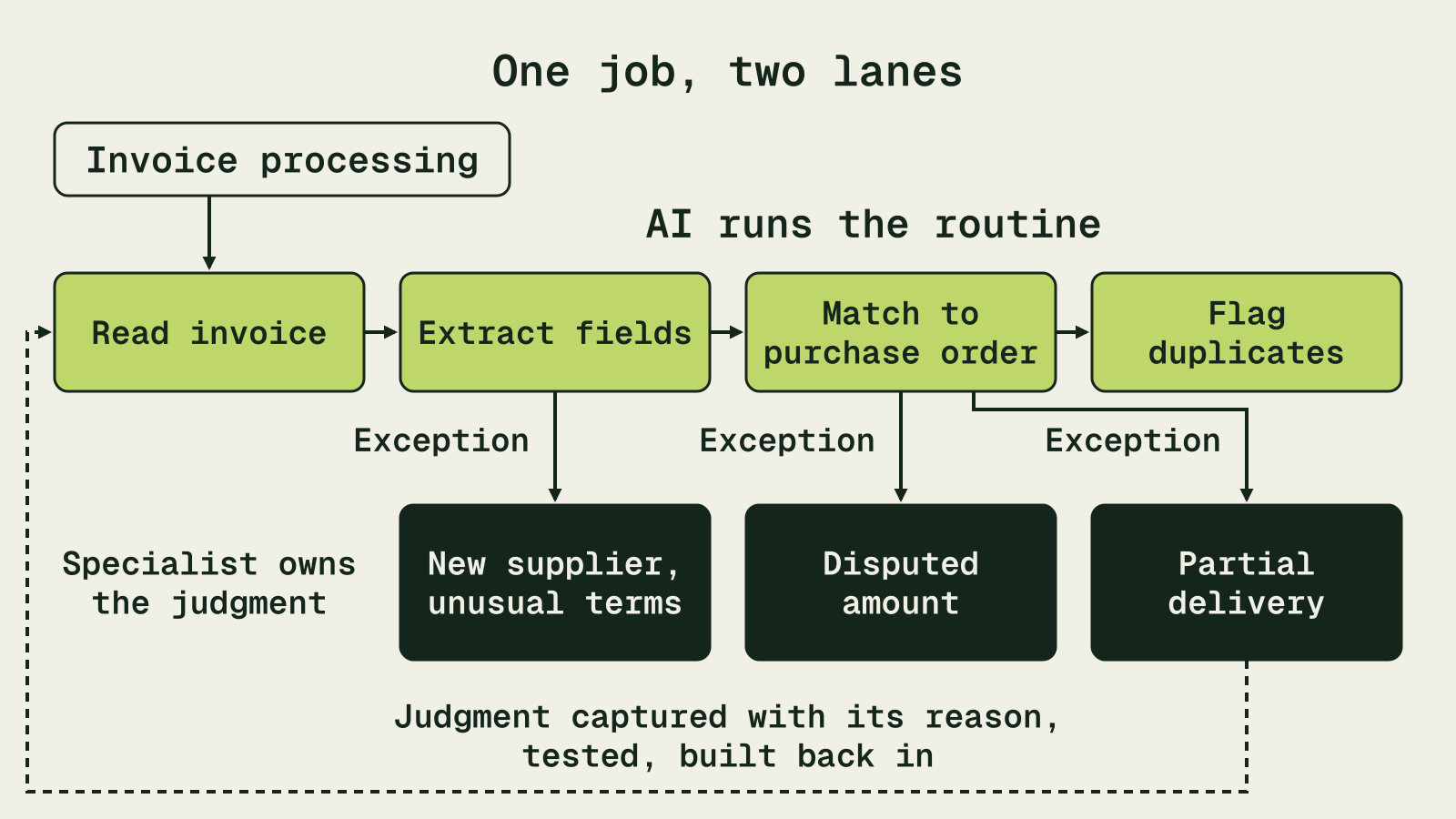
Take invoice processing. Reading the invoice, pulling out the fields, matching it to the purchase order and flagging duplicates repeat at volume and can be checked. Those steps suit an agent. A disputed amount, a partial delivery or a new supplier with unusual terms does not. Those go to a specialist.
Claims work splits the same way. Intake, document checks and routing are routine. Reading an unusual loss against the policy, or weighing conflicting evidence, is judgment.
The pattern holds across most services work. AI executes the routine. Specialists own the judgment. Every judgment a specialist makes is captured with its reason and built back in, as we describe in How does a data flywheel make each job cheaper in AI-native services?.
When does a "no" become a "yes"?
A workload that isn't ready today can be ready later. The signs above are conditions, not permanent verdicts.
The result gets defined and becomes checkable. Volume grows until the same kinds of case keep coming back. The data moves somewhere an agent can reach it. Captured judgments turn into tested patterns, so a kind of case that once needed a person can run as routine.
When that happens, start narrow. Put the agent on one slice of the work, with a specialist reviewing what it produces. Track how often its output needs rework and how many cases it sends back. Widen its share only when the evidence supports it. The goal isn't an agent on every step. It is each job needing less of a person's time than the last.
Questions people ask
When should you use AI agents?
Use them on work that repeats at volume, has a result you can check, and has inputs the agent can reach. They do best on the routine steps of a job, with the exceptions routed to a specialist.
What is the difference between an AI agent and regular automation?
Regular automation follows fixed rules and does the same thing every time. An AI agent decides its next step from what it reads, which lets it handle messier inputs but also makes its output vary. Where fixed rules work, they are usually the better choice.
Can AI agents make high-stakes decisions?
They can prepare them, but a person should own any decision that is costly, hard to undo or new. Agents are better at the routine checks and drafting that come before that decision.
How can you tell an AI agent pilot isn't working?
Watch how often a specialist has to redo the agent's output and how many cases it can't finish. If those numbers don't fall as captured judgments are built back in, the workload probably isn't a fit yet.
Questions or ideas? Email hello@skywakelabs.com.
Buyers, investors and partners: hello@skywakelabs.com
More notes
What is agentic BPO?
Outsourcing where AI agents work most cases and specialists take the exceptions. Real agentic BPO prices the finished case, not seats or agents.
ReadWill AI replace procurement teams?
Not the team. AI takes the paperwork of buying; people keep the decisions with no written answer: which supplier, on what terms and whether to buy at all.
Read