Will AI replace accountants?
No. AI takes the routine work and accountants keep the judgment. The open question is how new accountants learn judgment once AI does the work they learned on.
No. AI is taking over the routine parts of accounting, such as matching invoices to payments, sorting transactions and drafting reconciliations, while the judgment calls stay with accountants. The more important question is what happens to how accountants learn, because the routine work AI takes first is the work junior accountants have traditionally learned on.
Which accounting work is AI actually taking over?
Tasks, not jobs. The work AI handles well is the work that repeats: the same kinds of documents, the same checks and the same deadlines, for clients who look a lot like each other. We covered why accounting fits this pattern in Why is private equity buying accounting firms?
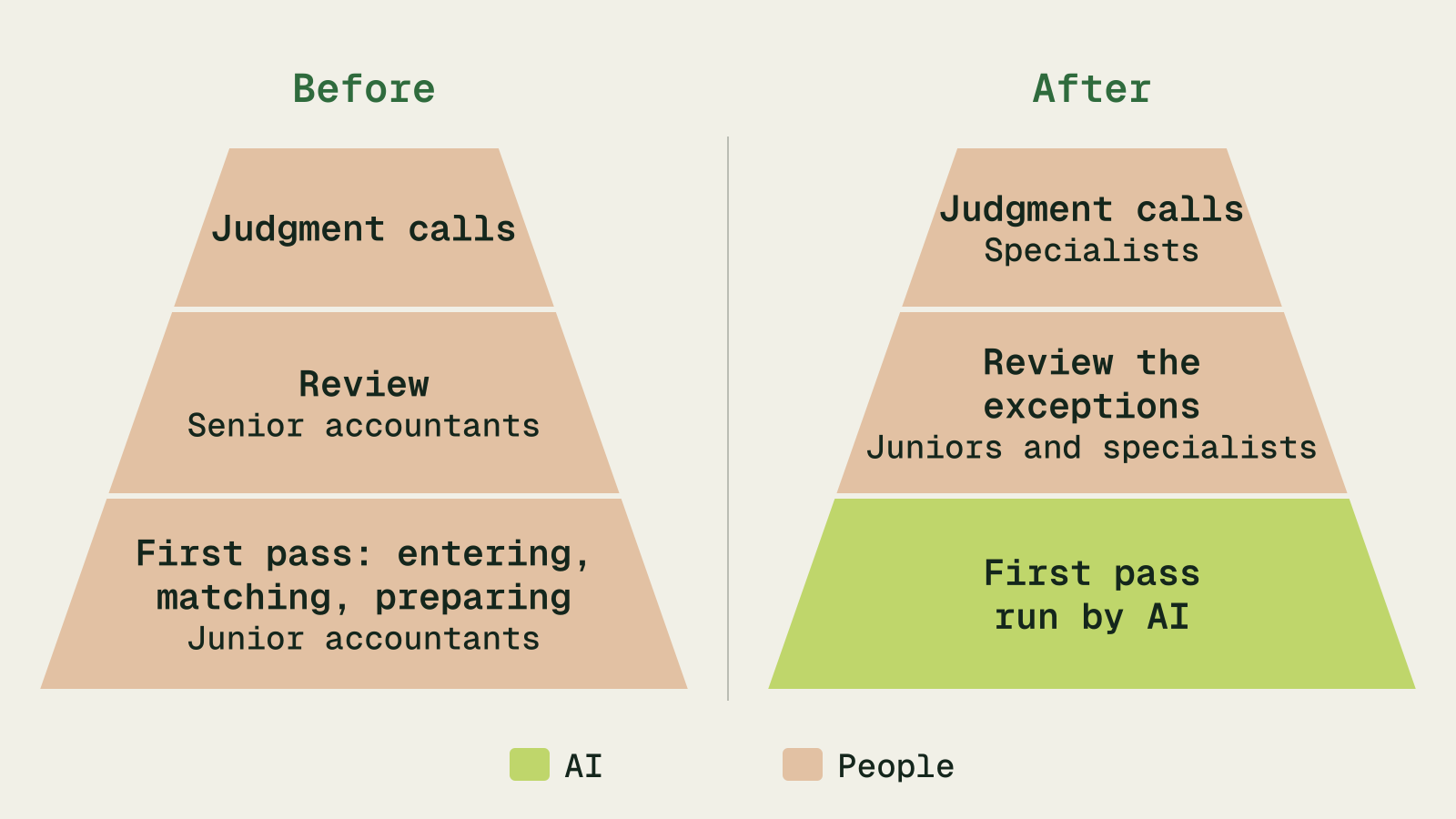
What changes is the shape of an accountant's day. Less of it goes to preparing, and more of it goes to reviewing. A system makes the first pass on a month of invoices and expense claims, and an accountant looks at what it could not settle: the invoice that doesn't match its purchase order, the expense claim coded to the wrong account, the payment that arrived without a reference. The accountant's job becomes deciding what those exceptions mean and what to do about them.
That is a real change in the work, and it is not the same as the work disappearing. Someone still has to understand the numbers well enough to know when one is wrong.
Why does junior work change first?
Because most of the routine sits at the bottom of the pyramid. In a traditional firm, junior accountants do the first pass: entering, matching, tying out and preparing. Senior people review it. When a system takes over the first pass, it is mostly junior hours that shrink, while the review and judgment above them stay.
That routine work has long done two jobs at once. It got the books done, and it trained people. Reconciling account after account is how a new accountant learns what a normal month looks like, and so how they learn to spot a month that isn't normal. Nobody designed it as training. It worked as training because there was so much of it.
Take the volume away, and the training goes with it unless something replaces it. In our view, this is the part of the question that matters most. A profession that only needs reviewers still has to produce people who can review, and good reviewers have usually learned by doing the work they now check.
How will new accountants learn judgment?
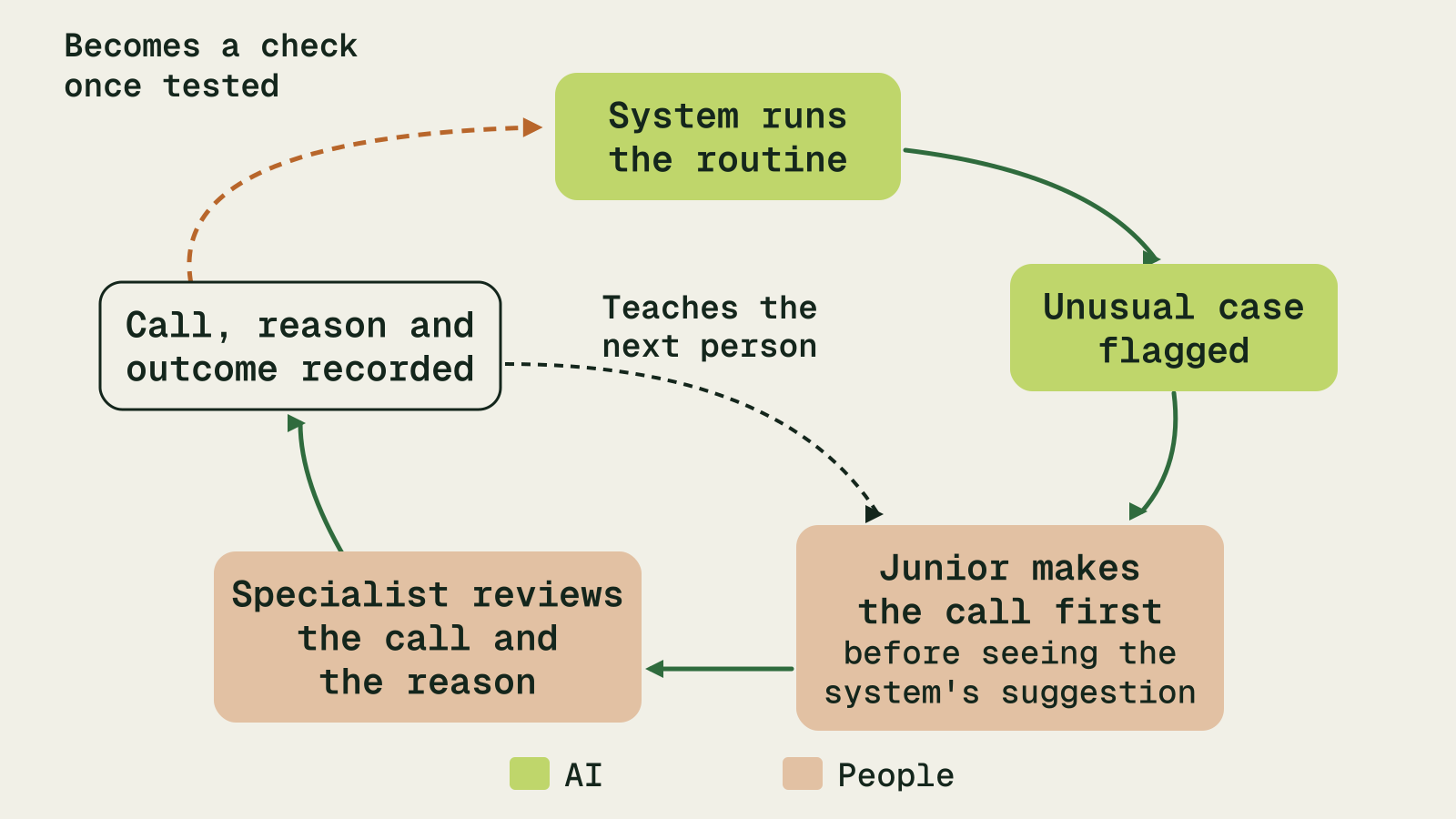
From the exceptions instead of from the volume. In a business built around AI, the system runs the routine and routes the unusual cases to people. Those unusual cases are exactly what a new accountant needs to see: the mismatches, the odd entries and the claims that don't fit a pattern.
We think the learning has to be designed deliberately, in three parts:
- Make the call first. On a sample of cases, a junior accountant decides before seeing what the system suggested. If they only ever approve a draft, they learn to approve, not to judge.
- Review it with a specialist. A senior specialist checks the call and the reason behind it, and where they disagree, says why.
- Capture the reason. The call, the reason and the outcome are recorded. Over time, that record becomes a library of real cases with real reasoning, and it does two jobs: it teaches the next person, and once a pattern is tested it becomes a check the system can run. We describe that second half in How does a data flywheel make each job cheaper in AI-native services?
In our view, the result is a shorter route to judgment than years of manual first passes, because every case a junior sees is one worth learning from.
What should businesses that buy accounting work ask?
Whether the people behind the work still understand it. When a firm's first pass is done by a system, the quality of the result depends on the people who review the exceptions and on how those people were trained.
Useful questions for any firm or provider:
- Who looks at the cases the system can't settle, and how experienced are they?
- How are new reviewers trained, now that there is less routine work to learn on?
- Are the reasons behind judgment calls recorded, so the same question gets a consistent answer next month?
- Is the work priced by the result or by the hour? With hourly billing, faster work means a smaller invoice, and the incentive to invest in better review weakens.
How do we approach this?
In our companies, each job is split into the steps a system can run and the decisions that need a person. AI executes the routine. Specialists own the judgment. Every judgment is captured with its reason and built back in, so the next job needs less of a person's time.
We treat that same record as how new specialists learn. The cases a system can't settle are the cases worth teaching from, and a captured reason teaches better than a marked-up spreadsheet. A business that gets cheaper with every job also has to keep producing people who can make the calls it can't automate.
Questions people ask
Will AI replace bookkeepers?
AI handles much of the routine in bookkeeping, such as categorizing transactions and matching payments to invoices. The role shifts toward reviewing the items a system can't settle and explaining the numbers to the business, which needs someone who understands how that business runs.
Which accounting tasks can AI do today?
AI does well on work that repeats: matching invoices to payments, categorizing transactions, drafting reconciliations, flagging items that don't reconcile and preparing first drafts of reports. Unusual transactions and questions without a precedent still need an accountant's judgment.
Will AI replace auditors?
AI can take on much of the repetitive testing and sampling in an audit and can look at far more transactions than a person could. Deciding what an unusual item means, and whether to dig further, stays with experienced people.
What does AI mean for a finance team's hiring?
Fewer hours go to entering and matching, so the roles that matter most shift toward review and judgment. Hire for people who understand what the numbers mean, and give new hires real exceptions to work on with an experienced reviewer, so the team keeps building the judgment a system can't supply.
Questions or ideas? Email hello@skywakelabs.com.
Buyers, investors and partners: hello@skywakelabs.com
More notes
What is agentic BPO?
Outsourcing where AI agents work most cases and specialists take the exceptions. Real agentic BPO prices the finished case, not seats or agents.
ReadWill AI replace procurement teams?
Not the team. AI takes the paperwork of buying; people keep the decisions with no written answer: which supplier, on what terms and whether to buy at all.
Read