What is agentic BPO?
Outsourcing where AI agents work most cases and specialists take the exceptions. Real agentic BPO prices the finished case, not seats or agents.
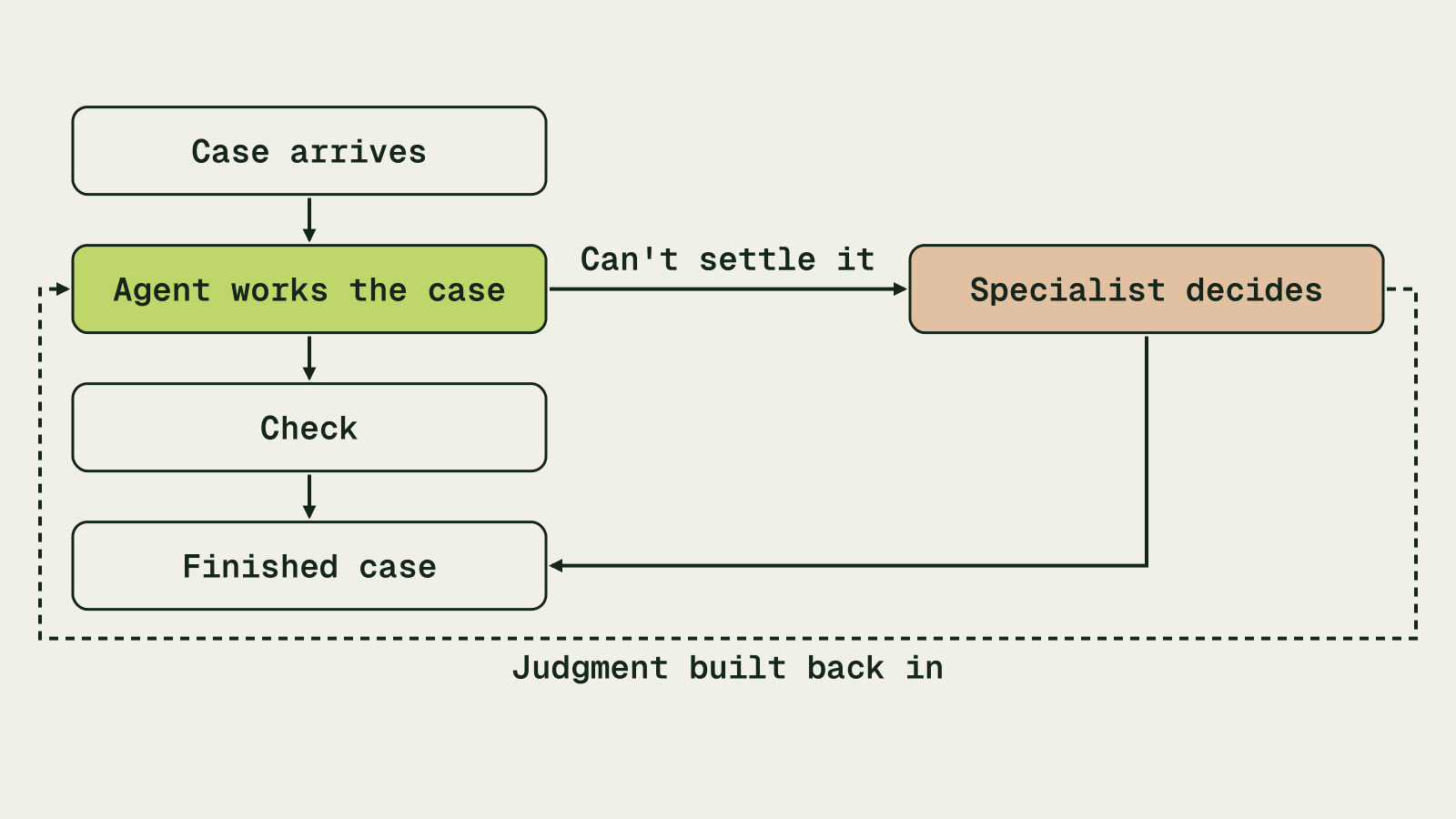
Agentic BPO is business process outsourcing in which AI agents work most cases in a process from start to finish, and a smaller team of specialists takes the cases the agents can't settle. Agentic process outsourcing, or APO, describes the same arrangement. What separates the real thing from a new label is what the contract pays for and where the people spend their day.
What does agentic BPO actually mean?
The term joins two ideas. BPO is the familiar trade: a company hands a back-office process, such as invoice processing or claims intake, to an outside provider. "Agentic" describes software that adapts to each case it is given, rather than running the same script every time. We cover that difference in AI agents vs RPA: what's the difference?.
Put together, agentic BPO means the provider runs the process with agents carrying the volume. The buyer doesn't get a system to operate. It gets the process run for it, with finished cases coming back.
The people don't disappear. They move. In a classic outsourcing team, most hours go to routine steps. In agentic BPO, the routine goes to agents, and specialists work the queue of cases that are unusual, disputed or need a decision no rule covers. Why the seat-based model is under pressure is a separate question, which we take up in Is AI replacing BPO?.
Is agentic process outsourcing the same thing?
Mostly, yes. Both names describe outsourced work that agents carry out. Where people draw a line, APO tends to mean a provider designed around agents from the start, while agentic BPO also covers older providers that have put agents alongside their existing teams.
For a buyer, the acronym matters less than which kind of provider is across the table. One built around agents sets its prices and staffing for that. One that has put agents into a team paid by the hour may still make most of its money from those hours, and you will see that in how it prices.
How can you tell agentic BPO from relabeled BPO?
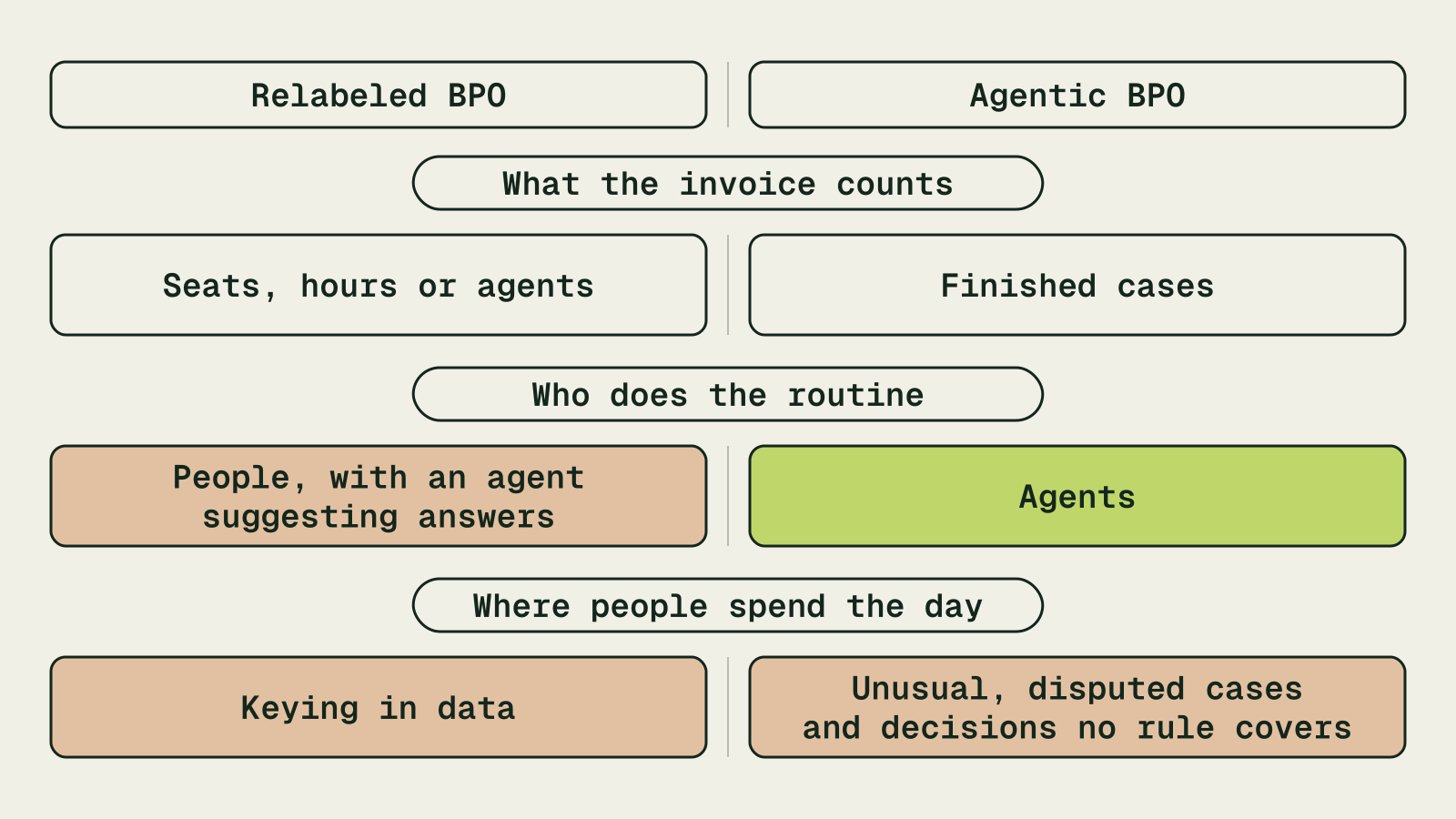
Plenty of providers now use the word. Four questions separate the substance from the label.
- What does the invoice count? If you still pay by the seat, the hour or the full-time head, the price rewards effort, not results. A monthly fee per agent is the same arrangement under a new name: it pays for capacity whether or not cases get finished. Real agentic BPO prices the finished case, as described in What is outcome-based pricing?.
- Where do the people work? Ask how a specialist's day splits between routine steps and exceptions. If people still key in data while an agent suggests answers, the agents are helping the old model, not replacing its routine.
- Can you see each case? You should be able to open any finished case and see what the agent did, what it checked and where a person stepped in, with the reason.
- Does the cost of a case fall? When a specialist settles an unusual case, that judgment should be captured and built back in, so the same kind of case needs less people time next time. We describe that loop in How does a data flywheel make each job cheaper in AI-native services?.
What should a buyer agree on before signing?
The contract is where agentic BPO becomes real or stays a slogan. Four things deserve a written answer.
- What counts as finished. Pick the unit you pay for, such as an invoice matched and posted or a claim file complete, and the test both sides use to accept it. A case that has to be redone shouldn't be billed as done.
- How exceptions are handled. Agree which cases go to a specialist, how quickly they are worked and what you see when they are.
- What happens as costs fall. If each case gets cheaper to deliver, decide up front how the price per case moves at each renewal, so the savings don't quietly sit with one side.
- What you keep when the contract ends. Case records, the written rules for handling exceptions and the judgments captured on your work are part of what you paid for. Agree that they come back to you in a form another provider, or your own team, could use.
To compare providers on your own cases rather than on a demo, see How should buyers evaluate AI agents?.
Why does the label matter less than the work?
Outsourcing labels change every few years. What buyers want from them hasn't: a process taken off their hands and finished to a standard they can rely on. In our view, agentic BPO is a promising way to get there, because agents can carry the volume while specialists put their time where judgment is needed.
The word alone guarantees nothing, though. A provider can call itself agentic while still selling hours. Another can deliver finished work with agents and specialists without ever using the term. That second kind is what we mean by an AI-native services company: AI runs the routine, specialists own the judgment, and each job lowers the cost of the next.
Questions people ask
Is agentic BPO the same as BPaaS?
Not quite. BPaaS sells a standard process run on the provider's own software along steps fixed in advance, typically billed as a subscription or per transaction. In agentic BPO, agents decide how to handle each case, and the price is more often tied to finished cases.
Does agentic BPO mean no people are involved?
No. Agents carry the routine cases, and specialists handle exceptions, disputed items and decisions no rule settles. The change is that people's time goes to judgment instead of data entry.
Which processes suit agentic BPO?
Processes where the same kinds of cases arrive in large numbers and a finished one can be tested, such as invoices, claims files and supplier records. Rare or judgment-heavy work suits it less, as we explain in When should you not use AI agents?.
Is agentic BPO cheaper than traditional BPO?
Only if the contract lets it be. When the price follows finished cases, falling delivery costs can reach the buyer at renewal; when it still pays for seats or agents, they may not.
Questions or ideas? Email hello@skywakelabs.com.
Buyers, investors and partners: hello@skywakelabs.com
More notes
Will AI replace procurement teams?
Not the team. AI takes the paperwork of buying; people keep the decisions with no written answer: which supplier, on what terms and whether to buy at all.
ReadAI agents vs RPA: what's the difference?
RPA repeats a fixed script and stops when a case doesn't fit; an AI agent reads each case and works out how to handle it. The real gap is in the exceptions.
Read