Will AI replace medical coders?
No. AI drafts codes for routine charts. Coders keep the judgment on what the record supports, clinician queries, and explaining codes in denials and audits.
No. AI can already read a chart and propose the codes for many routine visits, and that part of the job is moving to systems. What stays with medical coders is the judgment about whether the record actually supports a code: asking the clinician when it doesn't, settling the cases that don't fit a pattern, and explaining the codes when a claim is denied or audited.
What part of medical coding can AI already do?
The first pass. Coding turns a patient's chart into the standardized diagnosis and procedure codes that go on the claim. For a routine visit, much of that is pattern work: read the note, find the diagnoses and services, match them to codes, check the obvious rules. Many revenue cycle teams already run software that proposes codes from the note, and newer systems finish simple encounters before any coder opens the chart.
That fits the pattern of work that moves to AI first: charts that repeat, checks that repeat, and visits that resemble one another. It is the same shift we described for finance teams in Will AI replace accountants?, where the first pass moves to a system and people move to review.
What is different about coding is what the review is about.
Why is a code a judgment about evidence, not a lookup?
Because a code is a claim about what happened, and it is only as good as the record behind it. A system can find the word "pneumonia" in a note and propose the matching code. Whether the note supports that code, at that level of detail, for that visit, is a different question.
Three kinds of cases show the gap:
- The record is thin. The note hints at a condition but never states it, or leaves out the detail a more specific code needs. The right move is not to guess a code but to ask the clinician to clarify the record.
- The case is unusual. A long hospital stay, several conditions that affect each other, or a procedure described in a surgeon's own shorthand. These are the charts where a suggested code is a starting point, not an answer.
- The code gets challenged. A payer denies the claim or an auditor asks why a code was used. Someone has to read the record again and explain why it holds, or accept that it doesn't.
In each case, the work is deciding what the record supports. That is judgment, and it is the part of the job a suggested code does not do.
Where does a coder's time go once AI makes the first pass?
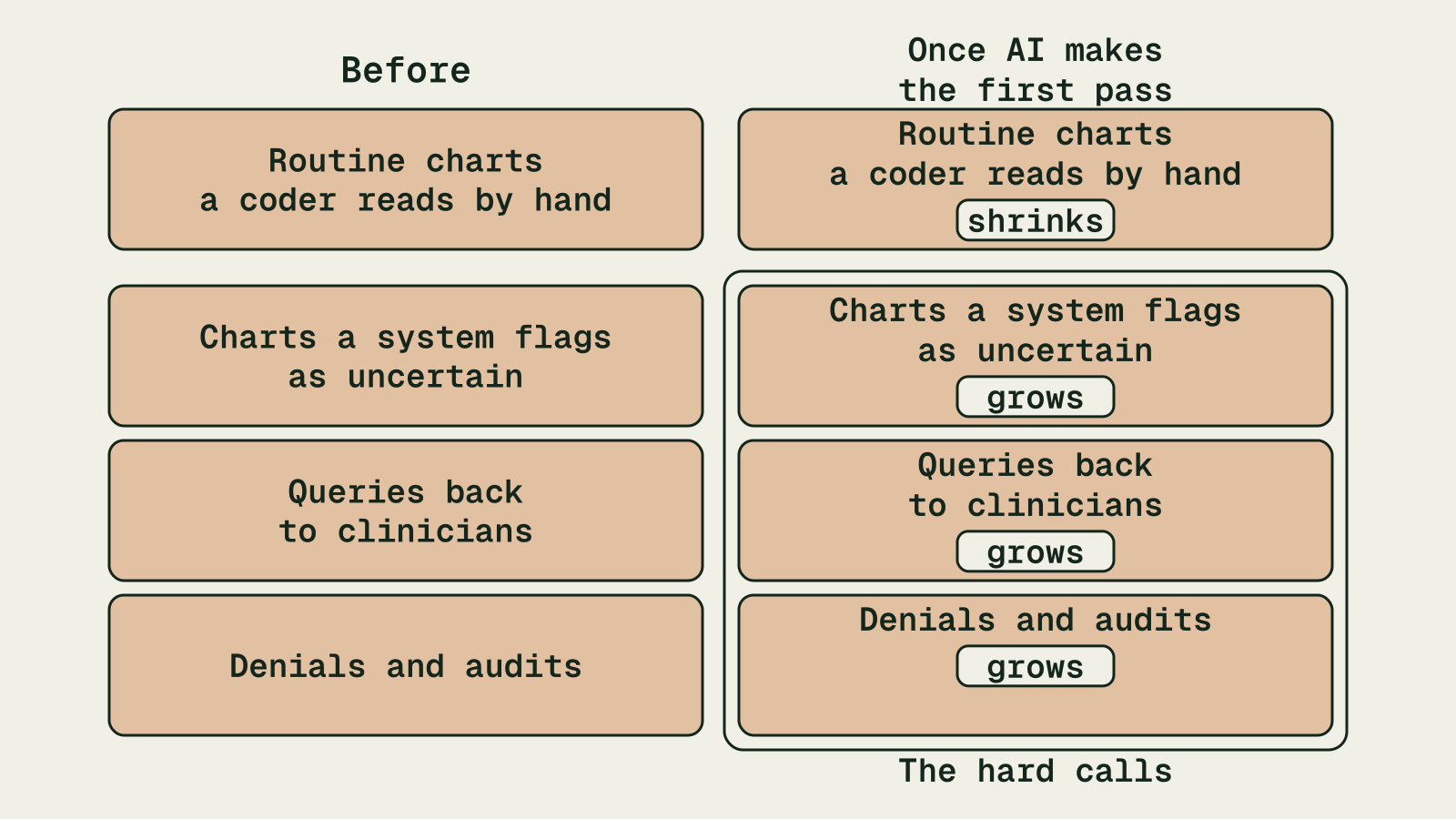
To both ends of the claim. Before the claim goes out, coders spend more time on the charts a system flags as uncertain and on queries back to clinicians when the record doesn't support what the visit seems to show. After the claim goes out, they spend more time on denials and audits: reading why a code was rejected, deciding whether to appeal, and explaining the reason.
The volume of routine charts a coder reads by hand shrinks. The share of their day spent on the hard calls grows.
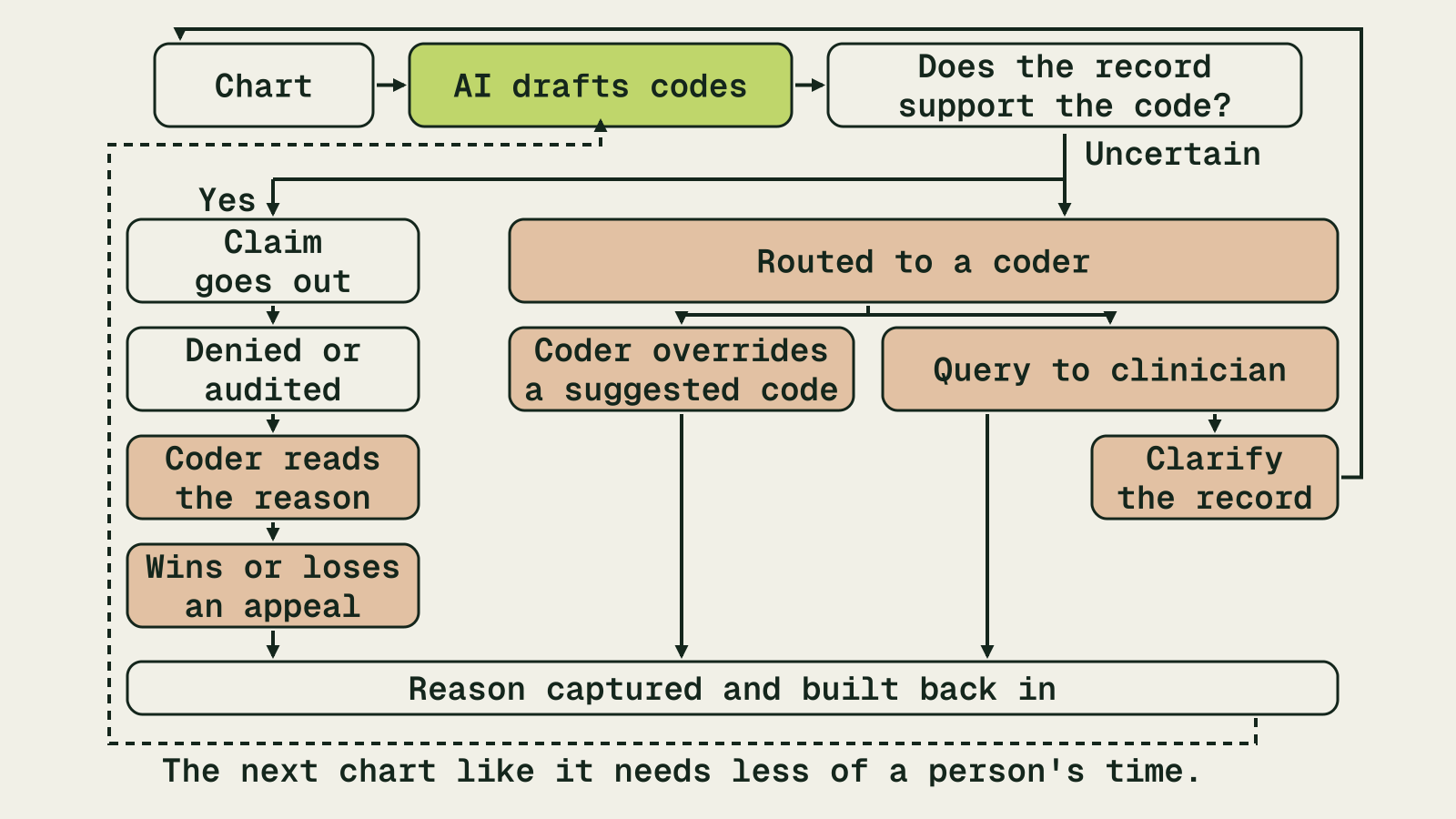
In a business built around AI, those hard calls are also where the system learns. Each time a coder overrides a suggested code, sends a query or wins or loses an appeal, the reason can be captured and built back in, so the next chart like it needs less of a person's time. We describe how that works in How does a data flywheel make each job cheaper in AI-native services? A denial is not just a lost payment. It is a reason, written by the payer, about why a code didn't hold.
What should a revenue cycle team ask before handing coding to AI?
Not "how accurate is the system?" on its own, but how the whole job runs. Useful questions for any provider or vendor:
- Which charts go straight through, and how are the uncertain ones routed to a coder?
- Who sends queries to clinicians when the record is thin, and how fast do they come back?
- When a claim is denied, who reads the reason, and does it change how the next chart is coded?
- Can the provider show why each code was chosen, in a way an auditor can follow?
- Is the work priced by the hour or the chart processed, or by the claim coded and paid? We cover why that matters in What is outcome-based pricing?
A team that only measures throughput will see the first pass get faster. A team that measures denials, queries and audit findings will see whether the judgment behind the codes is holding up.
How do we approach this?
In our companies, each job is split into the steps a system can run and the decisions that need a person. AI executes the routine. Specialists own the judgment. For coding, that means the system drafts codes from the record, and specialists decide what the record supports, ask when it is unclear, and explain the result.
Every one of those calls is captured with its reason. Over time, the charts that once needed a coder become charts the system can handle, and specialists spend their time on the cases that still need them. That is how the cost of each job keeps falling instead of dropping once and going flat.
Questions people ask
Will AI replace medical billers?
AI takes on much of the routine in billing, such as preparing claims, checking them against payer rules and tracking payments. Working denials, appealing them and handling unusual accounts still needs people who understand both the codes and the payer.
Can AI code medical charts without a human?
For simple, routine visits, systems can assign codes without a coder touching the chart. Complex stays, unclear records and challenged claims still need a coder's judgment, so a sound setup routes those cases to people rather than coding everything automatically.
What is computer-assisted coding?
Computer-assisted coding is software that reads the chart and proposes codes, which a coder then accepts or changes. Newer AI systems go further and code some encounters on their own, which moves the coder's role from assigning codes toward reviewing exceptions.
How does AI change coding audits?
A system can check every chart against coding rules, not just a sample, and flag the ones that look wrong. Deciding whether a flagged code is supported by the record, and explaining that decision, remains a coder's job.
Questions or ideas? Email hello@skywakelabs.com.
Buyers, investors and partners: hello@skywakelabs.com
More notes
What is agentic BPO?
Outsourcing where AI agents work most cases and specialists take the exceptions. Real agentic BPO prices the finished case, not seats or agents.
ReadWill AI replace procurement teams?
Not the team. AI takes the paperwork of buying; people keep the decisions with no written answer: which supplier, on what terms and whether to buy at all.
Read