Can AI take over accounts payable?
Mostly. AI can read, code and match invoices and work most exceptions. Approving spend, releasing payments and bank detail changes stay with your team.
Mostly, yes. AI can read invoices, code them, match them to purchase orders and receipts, and do the first review on most exceptions. What it shouldn't take over are the decisions about your money: approving spend outside the rules, releasing payments and changing where a vendor gets paid. The bigger question is whether you're buying software that helps your team do accounts payable, or the finished work itself.
What does "taking over" accounts payable actually mean?
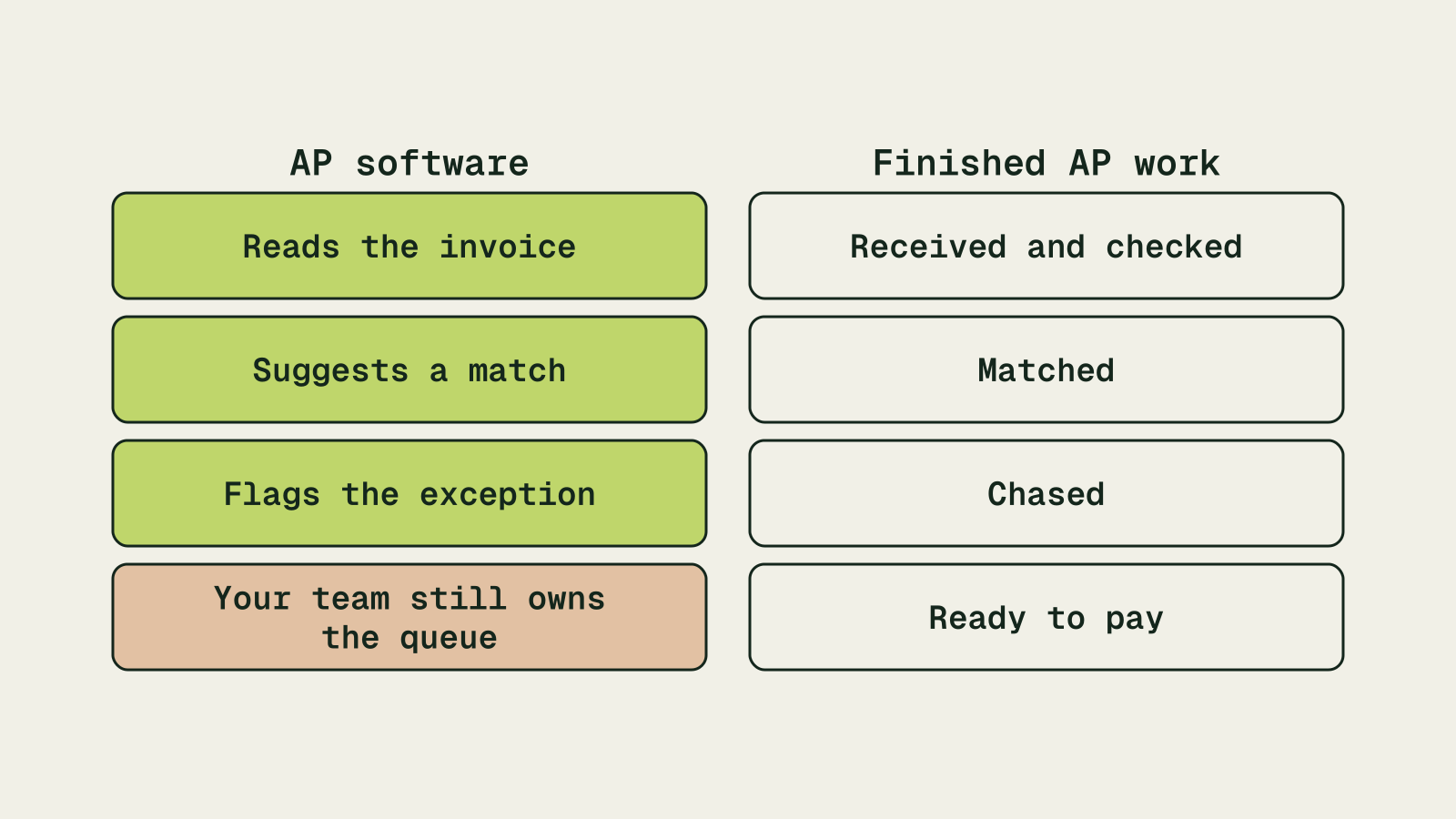
Two very different things get sold under the same words. One is software that reads invoices and suggests matches while your team still owns the queue. The other is the work itself: invoices received, checked, matched, chased and ready to pay, with someone else responsible for getting each one right.
The difference shows up in the exceptions. Software can flag a problem, but someone still has to email the buyer, find the missing receipt, ask the vendor for a credit memo and close the item. If that someone is still your team, you bought help with the work, not the work itself.
We cover the wider difference between buying software and buying finished work in What is service as software, and how is it different from SaaS?.
Why do exceptions decide whether AI can run your accounts payable?
A clean invoice is the easy part. It names a purchase order, its quantities and prices agree with the order and the goods receipt, and nothing about the vendor has changed. Checking that is a repeating step with a clear right answer, which is exactly what AI does well.
The real work sits in the invoices that don't agree:
- a price that differs from the purchase order
- a partial delivery, or a receipt nobody posted
- an invoice with no purchase order, or one raised after the invoice arrived
- a likely duplicate, sent twice or through two channels
- a vendor whose details just changed
For most of these, AI can do the first review. It gathers the order, the receipt, the contract and the email trail, checks each possible explanation against them and sets out what it found with a proposed fix. A person then makes the call. Most of the time in an exception goes on finding the evidence, not on deciding, so this is where the time comes back.
Some exceptions shouldn't be worked faster at all. When the same block keeps coming back, for example because nobody posts receipts for services, the fix belongs in how orders and receipts are handled. Working those exceptions faster just keeps the cause in place.
What should your own team keep?
Three decisions stay inside the business, however good the system gets.
- Approving spend outside the rules. An invoice that misses the match beyond the agreed tolerance, or has no order behind it, needs a named person to say yes.
- Releasing payments. The system can prepare the payment run and show exactly what is in it. Someone with authority signs off before money leaves.
- Changing where a vendor gets paid. We treat every request to change bank details as a fraud risk until it is verified. The system should never make the change itself: confirm the request by calling a contact already on file, not one given in the request, and have a second person approve it.
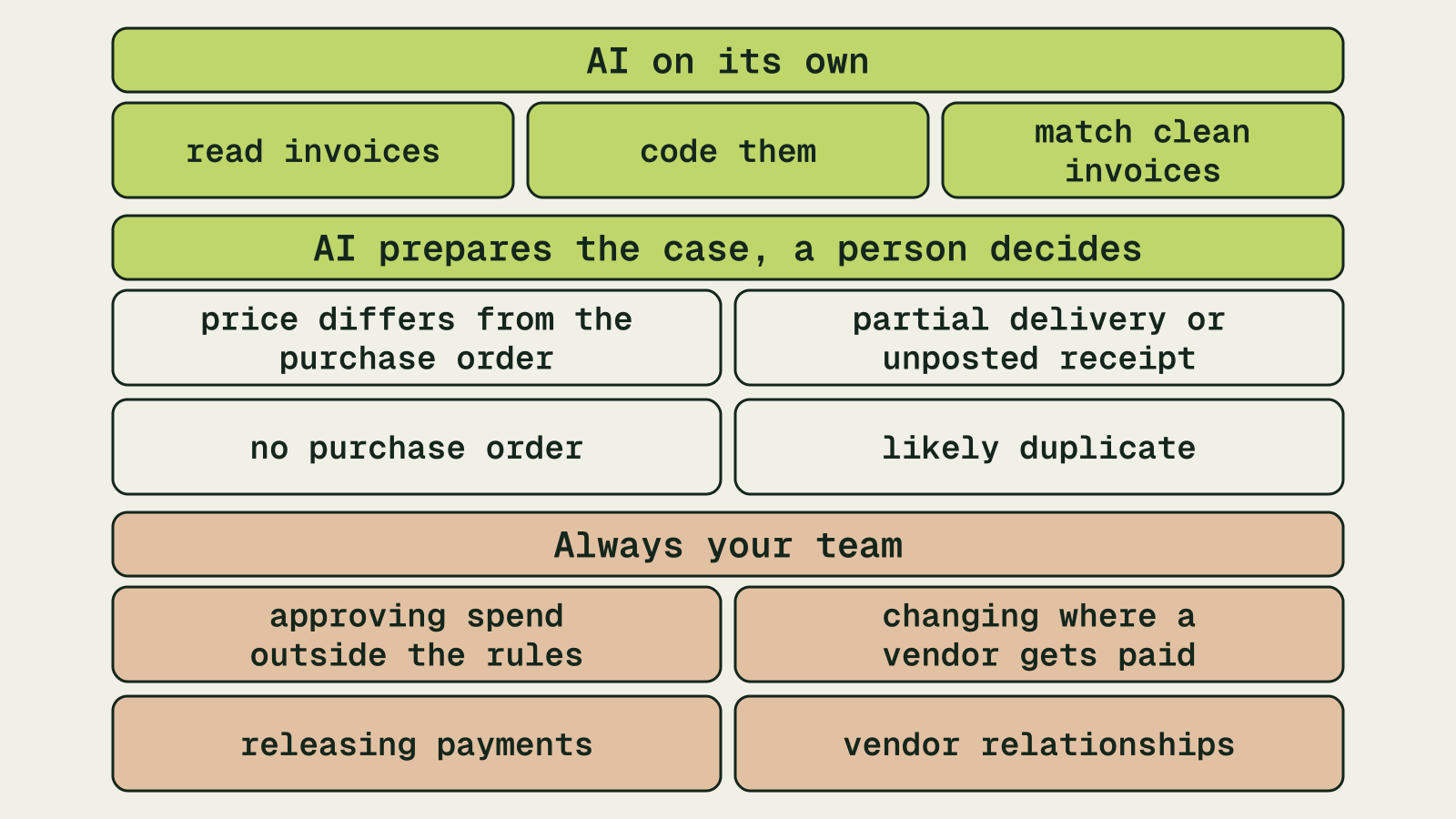
Vendor relationships stay with you as well. A dispute over a price or a late delivery is a conversation, not a match. We cover how to decide which calls need a person in Human in the loop vs human on the loop.
How should you buy accounts payable work that AI does?
If you are buying finished work, pay for finished work. A price per invoice processed correctly and on time ties the provider's interest to yours. A price per seat or per hour pays for effort. We explain the model in What is outcome-based pricing?.
Then ask the questions that show who really works the exceptions:
- Who closes an exception, from first look to resolved, and how long does one usually wait?
- Which steps run without a person, which need a named approver, and which always go to your team?
- Is every decision on an exception recorded with its reason, so recurring causes get fixed at the source?
- Is the cost of each finished invoice falling as the system learns your vendors?
The last question is the real test. Each exception closed with a reason should make the next similar one quicker, so the share that needs a person shrinks over time. For a fuller checklist, see How should buyers evaluate AI agents?.
Questions people ask
Will AI take over accounts payable jobs?
Much of the keying, coding and matching moves to AI. What your team keeps is exceptions, vendor questions and payment controls, so plan AP roles around judgment and controls rather than data entry.
Can AI do three-way matching?
Yes. Comparing an invoice with its purchase order and goods receipt is a repeating, checkable step that AI handles well. Invoices that match within tolerance can move on, and those that don't should get an AI first review and a person's approval.
Should AI approve invoices outside tolerance?
Not by itself. AI can prepare the case, with the evidence and a proposed fix, but a named person signs off on anything outside the agreed tolerance.
Is AI accounts payable software the same as outsourcing accounts payable?
No. Software helps your team process invoices faster, and your team still owns the queue and the exceptions. Outsourcing hands over the work itself, and AI-native services deliver that work with systems and specialists, priced by the result.
Questions or ideas? Email hello@skywakelabs.com.
Buyers, investors and partners: hello@skywakelabs.com
More notes
What is agentic BPO?
Outsourcing where AI agents work most cases and specialists take the exceptions. Real agentic BPO prices the finished case, not seats or agents.
ReadWill AI replace procurement teams?
Not the team. AI takes the paperwork of buying; people keep the decisions with no written answer: which supplier, on what terms and whether to buy at all.
Read