AI agents vs RPA: what's the difference?
RPA repeats a fixed script and stops when a case doesn't fit; an AI agent reads each case and works out how to handle it. The real gap is in the exceptions.
RPA (robotic process automation) repeats a set of recorded steps exactly and stops when a case doesn't fit them. An AI agent reads each case and works out how to handle it from what the case contains, which lets it take on messy inputs but makes its output less predictable. For a buyer, the difference that matters most is what happens to the cases neither one can finish, and whether the work gets cheaper as those cases are settled.
What does each one do when a case arrives?
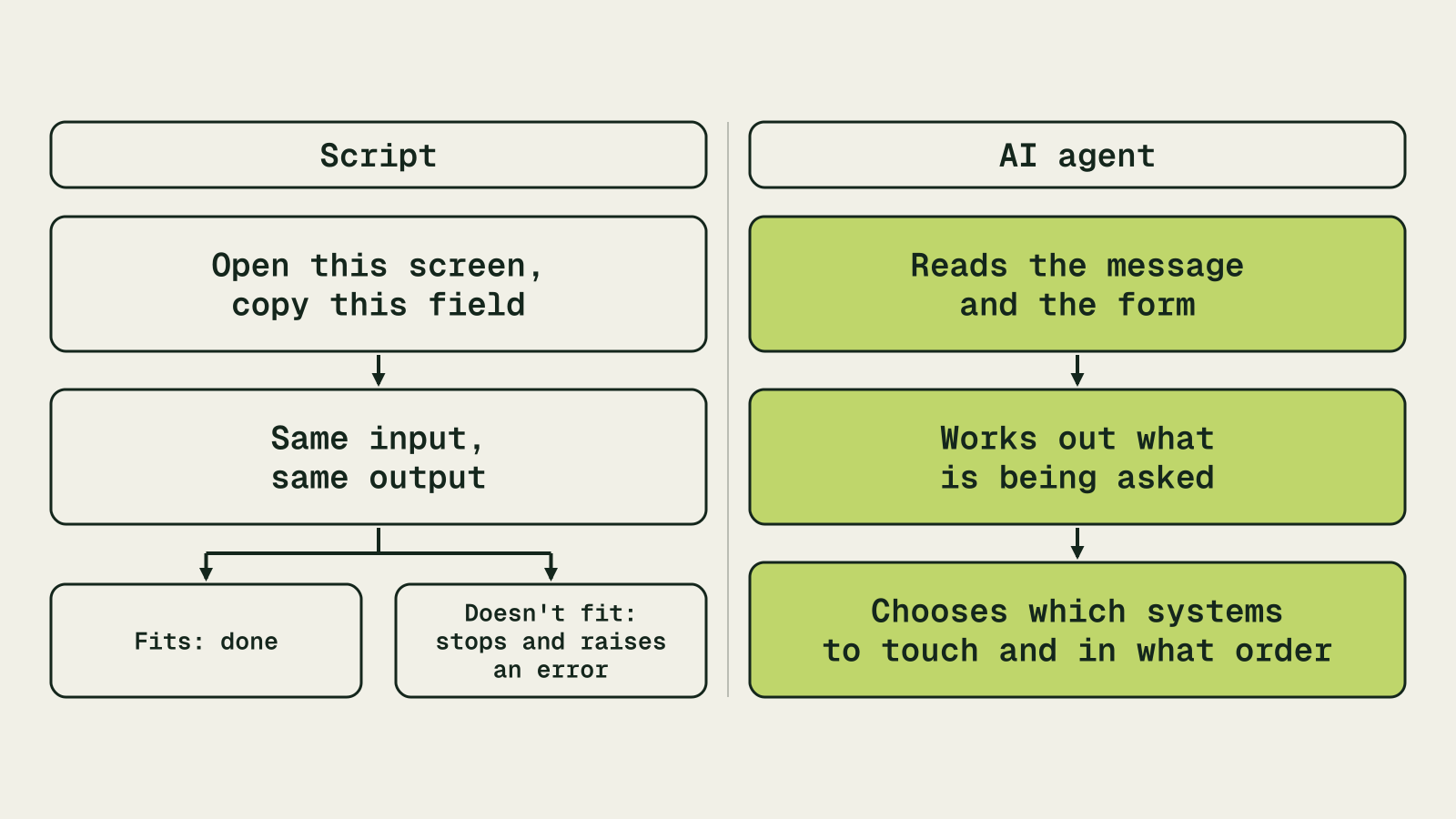
An RPA bot works like a recorded routine. Someone maps the steps once: open this screen, copy this field, paste it there, press submit. The bot then repeats them at speed, the same way every time. The same input always gives the same output, which is exactly what you want for steps that never change.
An AI agent starts from the case rather than the steps. Take a request to change an insurance policy that arrives as a customer's message with a signed form attached. The agent reads both, works out what is being asked, looks up the policy and chooses which systems to touch and in what order. A script can only handle that request if it arrives in the exact shape the script expects. The agent can handle the many ways people actually write.
So the split isn't old versus new. It is fixed steps versus variable cases, and most real jobs contain both.
How does each one break?
They fail in opposite ways, and that shapes how you control them.
A script breaks loudly. When a screen changes, a field moves or a document turns up in a new layout, the bot stops and raises an error. Scripts need upkeep whenever the systems around them change, but the failure is visible. Nobody mistakes a stopped bot for a finished job.
An agent tends to break quietly. It rarely stops; it produces an answer. Most of the time the answer is right. When it isn't, it can look just as confident: a change applied to the wrong vehicle on the policy, a date taken from the wrong page of the form. That is why agents need a check after each step, as we set out in How reliable are AI agents in production?
- With a script, the question is who fixes it when it stops.
- With an agent, the question is who notices when it is wrong.
Where do the exceptions go, and why does that decide the cost?
Every automated process has cases it can't finish. What happens to them decides whether the work gets cheaper over time, and most comparisons skip it.
With RPA, a case that doesn't fit the script drops into an exception queue and a person works it by hand. That person often knows exactly why the case broke and how to settle it. But the knowledge stays with them. The script doesn't change, so next month the same kinds of cases land in the same queue. Automation made the routine cheaper once. After that, the cost of the work goes flat.
An agent on its own doesn't fix this. Running a case doesn't teach it your work by itself. What changes the curve is how the work is set up around it. When a specialist settles a case the agent couldn't, the decision and its reason are recorded and built back in as a new instruction, a new check or a tested pattern. The next case of that kind runs as routine, and the queue shrinks instead of refilling. The loop behind this is in How does a data flywheel make each job cheaper in AI-native services?
That is the real choice. Not script versus model, but a setup where exceptions are a standing cost versus one where each exception lowers the cost of the next job.
Should you replace your RPA bots with AI agents?
Not by default. If a step never varies and its inputs always arrive in the same form, a script handles it predictably and usually costs less per run than a model call. Swapping it for an agent puts variation where none is wanted; the same point is made in When should you not use AI agents?
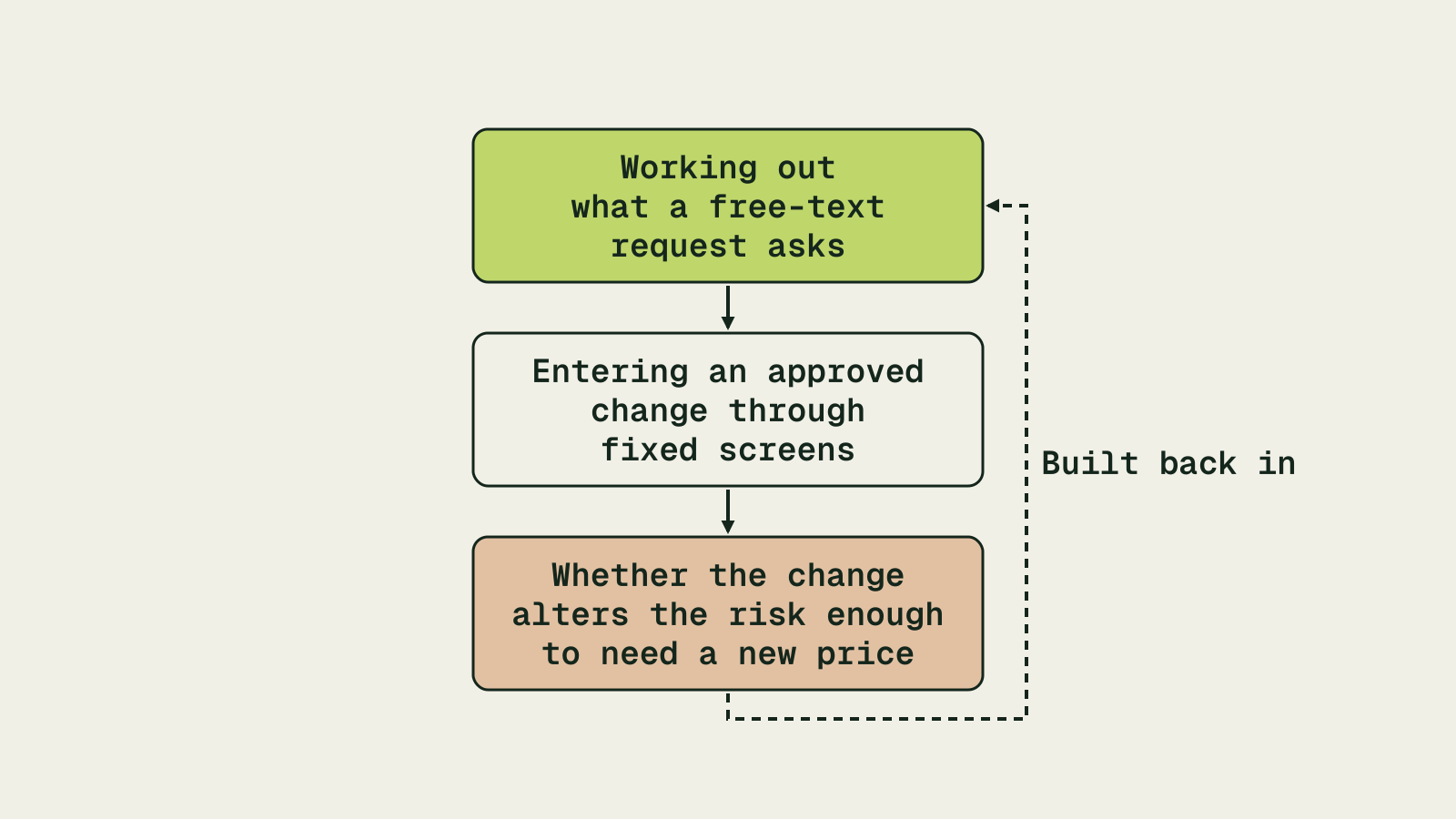
A better starting point is to look at where your scripts hand work to people. Those handoffs mark the steps that need reading or interpretation, and that is where an agent earns its place. For most jobs, the split looks like this:
- Scripts and rules for steps where the same input should always give the same result, such as entering an approved change into a system through its fixed screens.
- AI agents for steps that need reading, such as working out what a free-text request asks for or pulling the facts from a signed form.
- Specialists for the judgment calls, such as whether a requested change alters the risk enough to need a new price.
Start with the handoff that sends the most work to people today. Measure the people time behind each finished job before and after, and widen the agent's share only when that number falls.
Whichever mix you choose, scripts and agents are both things your team still runs: setting them up, keeping them current and staffing the queue behind them. Buying the finished work instead is a different trade, which we weigh in How should buyers evaluate AI agents?
Questions people ask
Is there still a place for RPA?
No. Scripts still run fixed, high-volume steps reliably and cheaply, and plenty of work is exactly that. What is fading is the idea of scripts as the whole answer, because the steps around them that need reading no longer have to go to people working a queue.
Can AI agents and RPA work together?
Yes. On a policy change, the agent works out what the request asks and prepares the change, a script enters the approved change through the system's fixed screens, and a specialist decides whether the change alters the risk enough to need a new price.
Is an AI agent just RPA with AI added?
No. Adding a model that reads documents to a script lets it accept more formats, but the script still follows its fixed path and stops when a case doesn't fit. An agent chooses its own path through the case within the limits it is given, which is why it needs different checks.
Which costs less to run, RPA or AI agents?
Per step, a script usually costs less than a model call. The cost that matters, though, is the people time behind each finished job, including the exception queue. Compare that, and how it moves over several months, rather than the price of a single run.
Questions or ideas? Email hello@skywakelabs.com.
Buyers, investors and partners: hello@skywakelabs.com
More notes
What is agentic BPO?
Outsourcing where AI agents work most cases and specialists take the exceptions. Real agentic BPO prices the finished case, not seats or agents.
ReadWill AI replace procurement teams?
Not the team. AI takes the paperwork of buying; people keep the decisions with no written answer: which supplier, on what terms and whether to buy at all.
Read