Is AI replacing BPO?
Not outright. AI is replacing the seat-based labor model inside BPO, not the need to hand off finished work. What buyers pay for is what changes.
Not outright. AI is replacing the labor model inside business process outsourcing (BPO): teams paid by the seat or the hour to run routine, high-volume steps. It is not replacing the reason companies outsource, which is to hand off finished work. What changes is who does the routine steps and what the buyer pays for.
What part of BPO is AI actually replacing?
BPO grew on a simple trade. A company moves repeatable back-office work to a team that does it at a lower cost per hour: invoice entry, claims intake, document checks, record cleanup, first-pass reviews. The provider earns its margin on people, and it grows by adding more of them.
That is the part AI goes after. The traits that made this work easy to outsource are the same traits that make it suit AI: it repeats at volume, it follows familiar patterns, and the result can be checked. Reading an invoice, pulling out its fields and matching it to a purchase order no longer needs a seat.
What AI doesn't remove is the work itself. The invoices still arrive. The claims still need a decision. Someone still has to deliver the finished result, every day, to a standard the buyer can rely on.
Why doesn't the need to outsource go away?
Because most buyers never wanted hours. They wanted the work off their desk, done well, without building a team to do it.
An AI agent doesn't give them that on its own. Someone has to define what a finished job looks like, set the system up, handle the cases it can't, and keep it current as suppliers, policies and rules change. The exceptions are where much of the cost and risk sit: a disputed invoice, a claim with conflicting evidence, a supplier record that doesn't match. Those need specialists who own the decision.
So the question for a buyer is less whether AI will do the work and more who runs it. Some work shouldn't go to an agent at all, which we cover in When should you not use AI agents?.
What happens to a BPO contract priced by the seat?
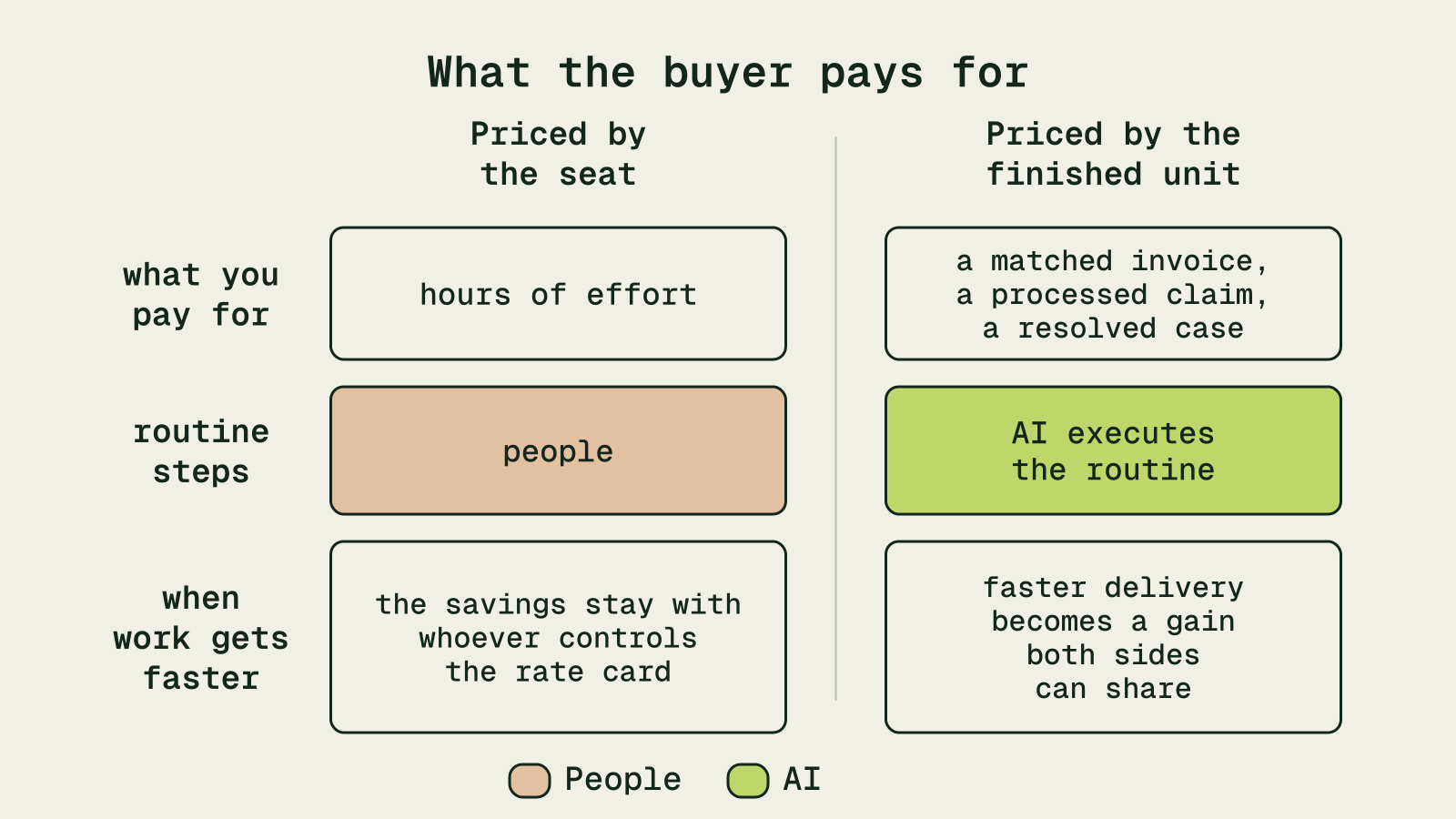
This is where the real disruption sits. A seat-based contract pays for effort. When AI takes over routine steps, the effort falls while the work stays the same.
That puts the buyer and a seat-based provider on opposite sides. If the provider automates, it bills fewer seats and earns less. If it doesn't, the buyer keeps paying for hours a system could cover. Unless the price unit changes, the savings stay with whoever controls the rate card.
The fix is to price what the buyer actually wants: a matched invoice, a processed claim, a resolved case. We explain the model in What is outcome-based pricing?. Once the price is attached to the finished unit, faster delivery becomes a gain both sides can share instead of a quiet loss for one of them.
What should a buyer with an outsourcing contract do now?
Start with the work, not the vendor.
- Split each process into steps. Mark which steps repeat and can be checked, and which turn on a person's judgment.
- Ask what the provider's people actually do. If more of the work now runs through software, the bill should reflect it.
- Define the finished unit. Write down what "done" means for one invoice or one claim, and how you would check it.
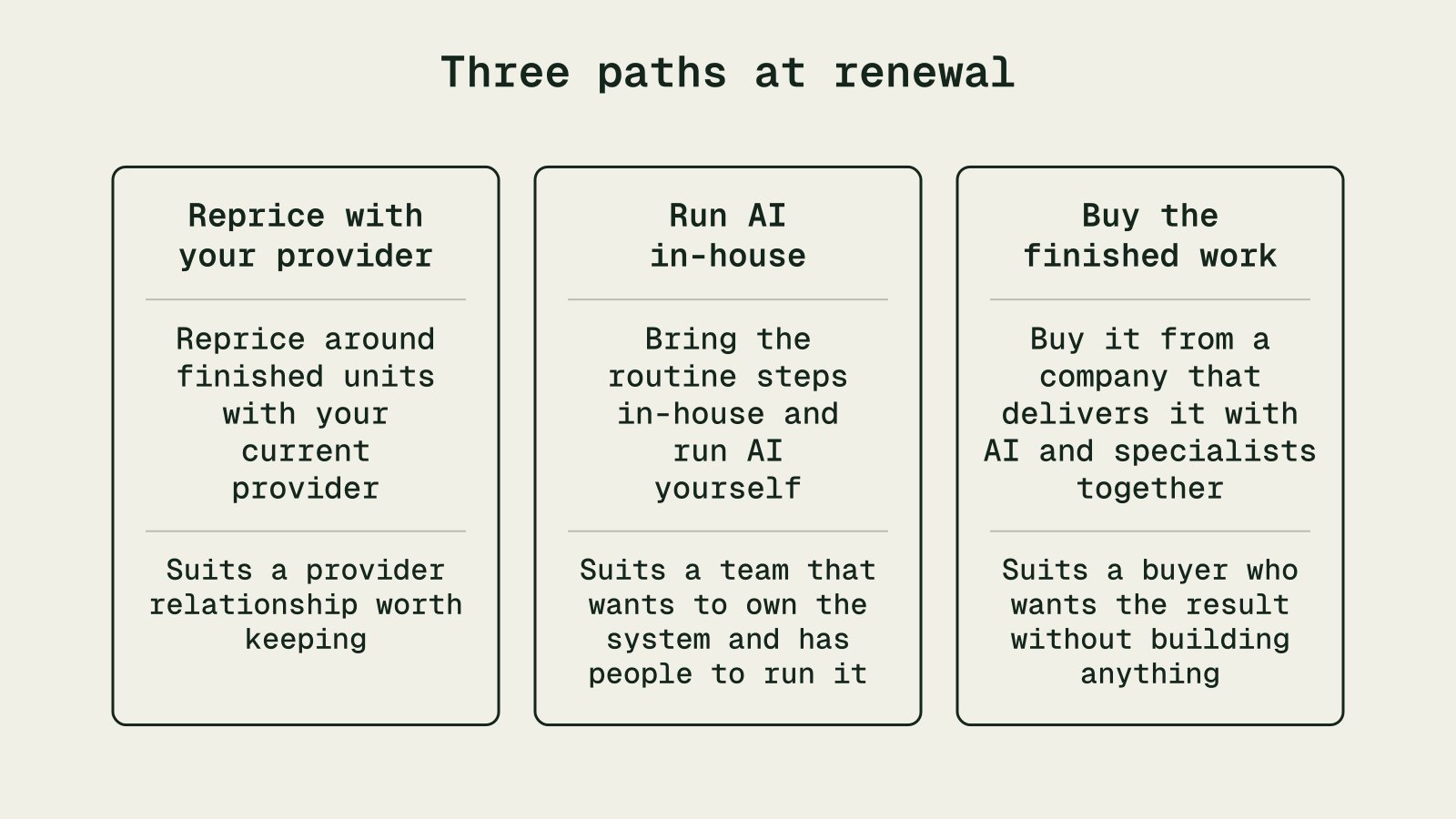
- Choose a path at renewal. Reprice with your current provider around finished units, bring the routine steps in-house and run AI yourself, or buy the finished work from a company that delivers it with AI and specialists together.
Each path suits a different buyer. Running AI in-house fits a team that wants to own the system and has people to run it. Repricing fits a provider relationship worth keeping. Buying finished work fits a buyer who wants the result without building anything. That last model is what we mean by an AI-native services company.
What does outsourcing look like once AI runs the routine?
Fewer seats, more of the work in software, and specialists concentrated on the cases that need them. The price follows the finished unit, not the headcount behind it.
The provider's edge changes too. It used to come from cheaper hours. Now it comes from how fast each job gets cheaper to deliver than the last. AI executes the routine. Specialists own the judgment. Every judgment a specialist makes is captured with its reason and built back in, so the same exception costs less the next time it appears. We describe that loop in How does a data flywheel make each job cheaper in AI-native services?.
A provider that still sells hours is selling the part of the work that is shrinking. A provider that sells finished work, and keeps getting faster at it, is selling the part that stays.
Questions people ask
Will AI replace BPO jobs?
It is taking over many of the routine tasks those jobs were built around. The work that stays is exception handling, quality review and the judgment calls a system routes to a person, so the roles that remain sit on exceptions and judgment, not volume.
Which outsourced work is AI taking over?
High-volume back-office steps with a result you can check: invoice capture and matching, claims intake and document checks, data entry and record cleanup. Work that is mostly judgment changes more slowly.
Should I cancel my outsourcing contract because of AI?
Not on that basis alone. First find out which steps could run through software, what your provider is doing about it and how the price would change. Renewal is the natural point to change the price unit or the model.
Is BPO still worth it with AI?
It can be, when you buy finished work at a price tied to results. It is harder to justify when you pay by the seat for steps a system can handle.
Questions or ideas? Email hello@skywakelabs.com.
Buyers, investors and partners: hello@skywakelabs.com
More notes
What is agentic BPO?
Outsourcing where AI agents work most cases and specialists take the exceptions. Real agentic BPO prices the finished case, not seats or agents.
ReadWill AI replace procurement teams?
Not the team. AI takes the paperwork of buying; people keep the decisions with no written answer: which supplier, on what terms and whether to buy at all.
Read