How reliable are AI agents in production?
Reliable on short steps with a checkable result, shaky on long chains run alone. Reliability is something you design into the work.
AI agents are reliable on short, well-defined steps whose result someone can check, and much less so on long chains of work they run alone. In production, reliability is something you design into the work: small steps, checks between them, and a specialist on the cases the agent can't settle.
Why does an agent that works in a demo stumble in production?
A demo is one run on cases someone chose. Production is thousands of runs on whatever arrives that day. Three things change between the two.
- Rare cases show up. At volume, the unusual invoice or the claim with a missing document stops being rare. It turns up every week.
- Jobs get longer. A demo often shows one task. A real job strings many tasks together, and each one depends on the last.
- The inputs keep moving. Suppliers change their invoice layouts, policies get new wording, and the systems the agent reads from get updated. An agent that was right last month can drift without anyone changing it.
How to test an agent against your own cases before you buy is covered in How should buyers evaluate AI agents?. This note is about what keeps it working after that.
Why do long jobs break more often than short ones?
Because small misses multiply. Take a made-up example: suppose each step in a job comes out right nine times in ten. Then a job of five such steps finishes clean only about six times in ten, and every added step lowers that.
Order matters too. A mistake early in a job doesn't stay put; every later step builds on it. If an agent misreads the amount on an invoice, the purchase order match is wrong, the approval goes to the wrong queue and the payment record is wrong as well. By the time anyone looks, one misread number has become four problems.
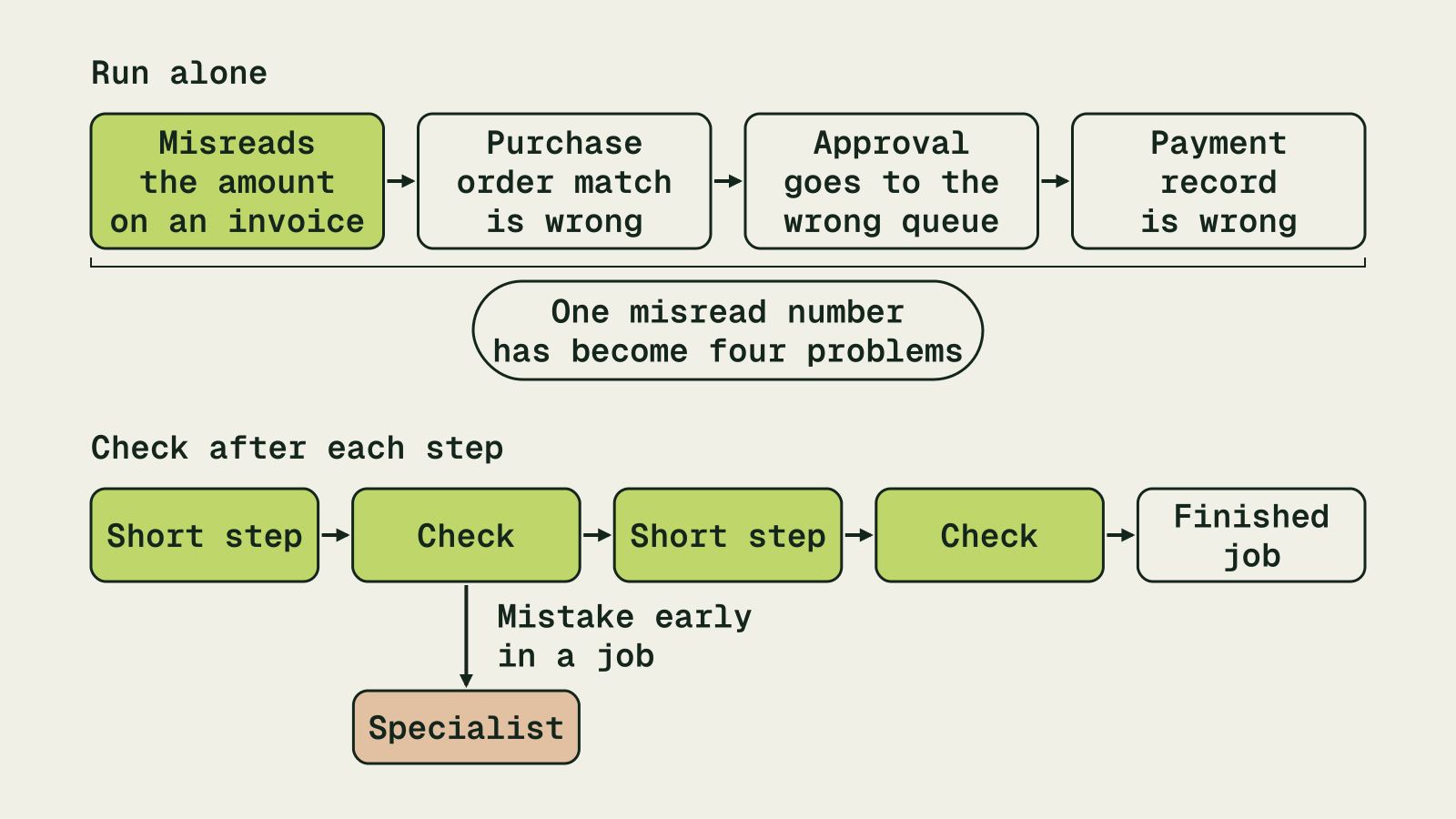
That is why we keep each run short and put a check after each step, rather than letting one agent carry a job from start to finish unchecked.
Why can the same agent handle the same case differently?
An agent doesn't follow a fixed script. Given the same claim file twice, it may read the documents in a different order, call different systems and land on a different answer. Most runs may be right. The trouble is not knowing in advance which ones won't be.
So consistency is its own measure, separate from accuracy. An agent that gets a case right on one run and wrong on the next is hard to plan around, even if its average looks good. The practical test is simple: run the same cases several times and see whether the results hold.
Where the same input must always give the same output, a rule does that job better than an agent, as we explain in When should you not use AI agents?.
What makes an AI agent reliable in production?
Reliability isn't something you buy with a model. It is something you build into the work. Here is how we approach it in our companies.
- Cut the job into short steps. Each step gets one clear task and a result that can be checked on its own.
- Check between steps, not only at the end. Rules handle what rules can, such as totals that must add up or a policy number that must exist. People handle what needs judgment.
- Give the agent a way to stop. When a case falls outside what it handles well, it hands the case to a specialist with its notes and the reason it paused, instead of guessing.
- Watch the work, not just the system. Track finished jobs, rework and handoffs week by week. A system can be up and running while the work it produces quietly gets worse.
- Build every judgment back in. When a specialist settles a hard case, the decision and its reason go back into how the work runs, so the same case needs less of a person's time next time. We describe that loop in How does a data flywheel make each job cheaper in AI-native services?.
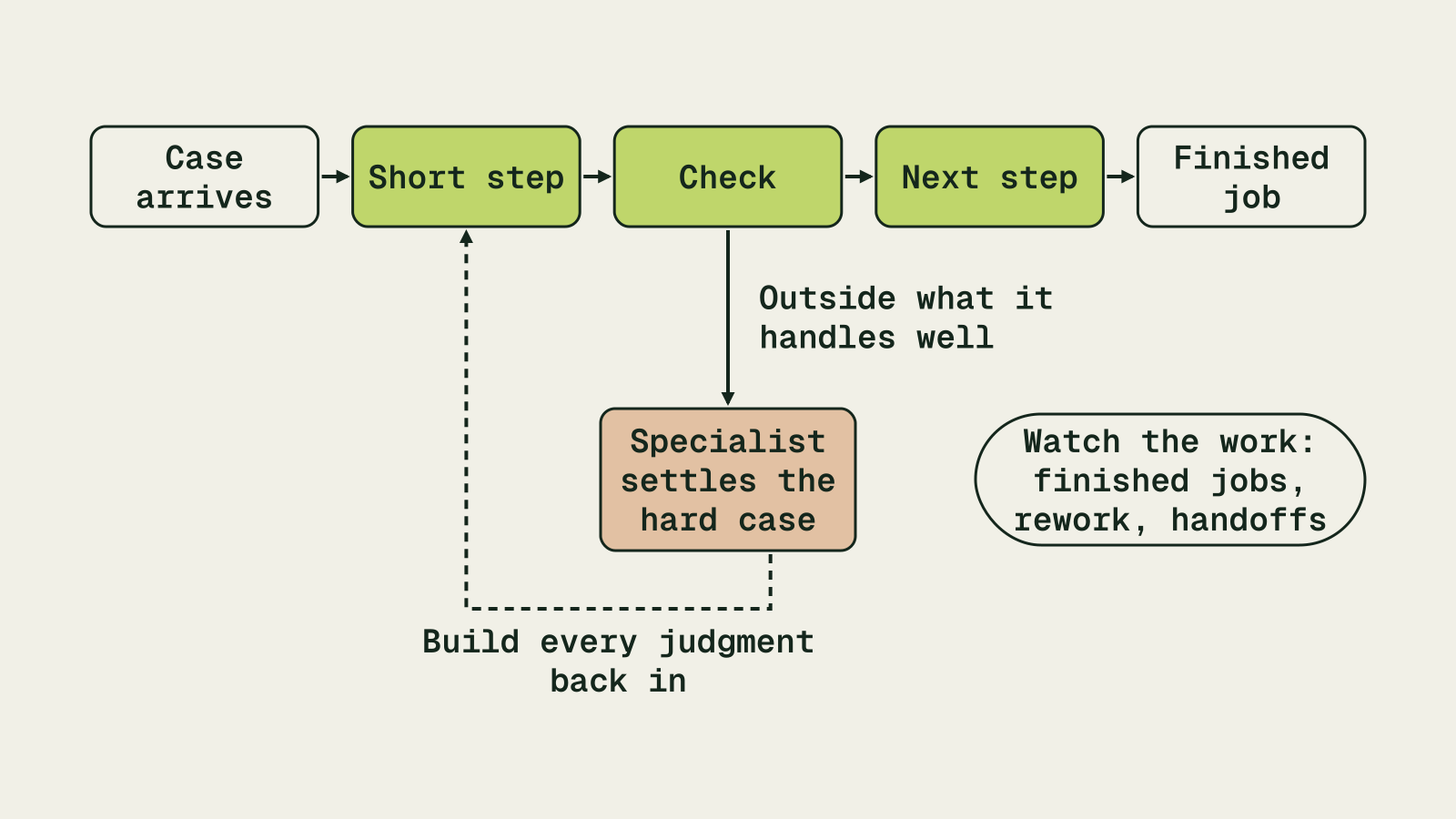
AI executes the routine. Specialists own the judgment. Reliability is what you get when that split is designed into every step, not added as a review at the end.
What should a buyer ask about reliability?
"How accurate is it?" is the start, not the whole question. The better questions are what happens when the agent is wrong, who notices, and who does the rework.
If you run an agent yourself, your team finds and fixes its misses, and keeps it current as your inputs change. That cost belongs in the comparison. If you buy the finished work instead, priced by the result, misses and exceptions are the seller's to fix, and you pay only for jobs that are done. We cover that model in What is outcome-based pricing? and What is an AI-native services company?.
Either way, an agent's reliability is only as good as the system around it.
Questions people ask
Are AI agents reliable enough for business use?
Yes, for short, well-defined tasks with a result that can be checked, such as reading invoices or sorting incoming claims. They are much less dependable on long, multi-step jobs run without checks, so it pays to keep a person on the hard cases.
Why do AI agents fail in production?
Mostly because production is harder than a demo: more unusual cases, longer chains of dependent steps, and inputs that keep changing. Small errors early in a job carry into every step after it.
How do you make an AI agent more reliable?
Break the work into short steps, check each result before the next step uses it, and give the agent a clear way to hand off cases it can't settle. Then track finished jobs and rework over time, and build each specialist judgment back in.
Should AI agents run without human review?
Only on routine steps where a wrong result is easy to catch and cheap to fix. Where a mistake is costly or hard to spot, a specialist should make the call before anything happens.
Questions or ideas? Email hello@skywakelabs.com.
Buyers, investors and partners: hello@skywakelabs.com
More notes
What is agentic BPO?
Outsourcing where AI agents work most cases and specialists take the exceptions. Real agentic BPO prices the finished case, not seats or agents.
ReadWill AI replace procurement teams?
Not the team. AI takes the paperwork of buying; people keep the decisions with no written answer: which supplier, on what terms and whether to buy at all.
Read