Why is private equity buying accounting firms?
Recurring work, loyal clients, scattered ownership and retiring partners. AI raises the stakes: the payoff depends on how the work is rebuilt and priced.
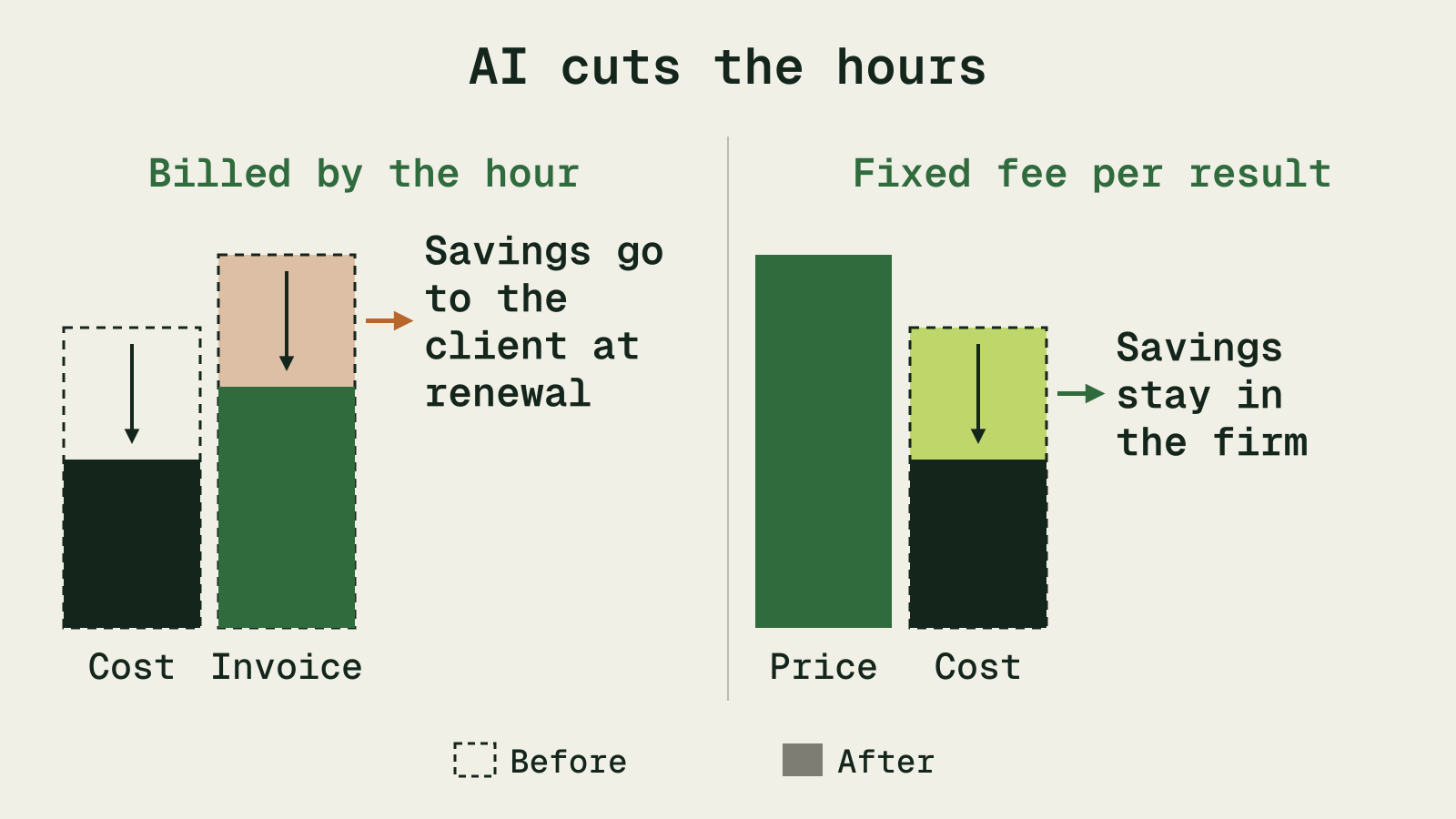
Private equity is buying accounting firms because the work comes back every year, clients tend to stay for years, ownership is spread across thousands of small partnerships, and many partners nearing retirement have no successor inside the firm able to fund a buyout. AI now sits inside that case as well. In our view, it decides which of these deals pay off: a firm whose work is rebuilt around AI and priced by the result gets cheaper to run with every engagement, while a firm that keeps billing by the hour hands most of the savings to its clients.
What makes an accounting firm attractive to a buyer?
The standard case rests on four features, and none of them is new.
- The work recurs. Tax returns, audits, bookkeeping and the monthly close come back on a calendar. Revenue that arrives on a schedule is easier to plan around than revenue that has to be won again each year.
- Clients stay. Changing accountants is slow and risky for a client, so relationships tend to run for years and renew without much selling.
- Ownership is scattered. The profession is made up of many independent firms. A buyer can grow by combining them and sharing the back office.
- Partners need a way out. Many firms are owned by partners close to retirement, and the next generation often cannot fund a buyout on its own. A sale to an outside buyer becomes the practical answer to succession.
On those four features alone, an accounting firm looks like a steady, low-drama asset. What has changed is that the same features that make the revenue predictable also make the work a strong fit for AI.
Why does AI change the math on accounting firms?
Recurring work is repeating work. The same kinds of documents arrive, the same checks run and the same deadlines come around, for clients who look a lot like each other. That is the kind of work where AI can run the routine: matching invoices to payments, sorting transactions, assembling a first draft of a return, flagging the items that don't reconcile.
The judgment stays with specialists. An unusual transaction, a client question with no precedent, a position that needs a reason behind it: those are decisions a person owns. When the routine moves to a system, an accountant's time moves to those decisions.
This matters more because many firms already struggle to hire enough accountants. When capacity, not demand, limits how much work a firm can take on, every hour moved off the routine is an hour that can go to another client.
Why can AI still disappoint the buyer?
Because most accounting work is still billed by the hour. When AI cuts the hours behind a return or a monthly close, the invoice shrinks with them, and the buyer who paid for hourly revenue watches it fall. A fixed fee per return, per monthly close or per finished audit file keeps that gain in the firm; more in What is outcome-based pricing?
Licensing AI software without changing how the work runs saves money once and then stalls, as we explain in Does buying a services business and adding AI actually work?
So the questions that decide the deal come after the purchase: how the work is delivered, and how it is priced.
What separates an accounting deal that compounds from one that stalls?
The accounting calendar. Monthly closes and yearly returns come back for clients who look alike, so when a reviewer decides how to treat an unusual invoice, that decision can become a check used again at the next close. A deal compounds when the work is rebuilt to capture those calls; the general case is in Does buying a services business and adding AI actually work? and How does a data flywheel make each job cheaper?
A buyer combining many firms faces one more test: whether what is learned in one firm moves to the others. That is the subject of What is an AI roll-up?
What should partners and clients ask before a deal?
For partners weighing an offer, the useful questions are about the work, not only the price. What will change in how engagements are delivered? Who will own the judgment calls, and how will their decisions be recorded? Will the firm keep billing by the hour, and if so, what happens to revenue as the hours fall?
For clients of a firm that changes hands, the questions are simpler. Will fees move from hourly to fixed? Who reviews the work before it is signed off? How will quality be checked as more of the routine moves to systems?
The answers say more about a deal's future than the purchase price does.
Questions people ask
Why are accounting firms selling to private equity?
Many partners are nearing retirement, and the next generation often cannot fund a buyout on its own. A sale gives retiring partners a way out and gives the firm capital to invest in technology and staff that a partnership often pays out rather than keeps.
Is private equity ownership good for accounting firm clients?
It depends on what the new owner does with the firm. If the work is rebuilt and priced by the result, clients can get faster, more consistent work at a known price. If the plan is mainly to cut costs while billing the same way, service can suffer.
Will AI make accounting firms less valuable?
Hourly revenue is under pressure, because AI reduces the hours behind routine work. In our view, firms that rebuild their delivery and price by the result can become more valuable, because their cost of work keeps falling while the price of the result holds.
Questions or ideas? Email hello@skywakelabs.com.
Buyers, investors and partners: hello@skywakelabs.com
More notes
What is agentic BPO?
Outsourcing where AI agents work most cases and specialists take the exceptions. Real agentic BPO prices the finished case, not seats or agents.
ReadWill AI replace procurement teams?
Not the team. AI takes the paperwork of buying; people keep the decisions with no written answer: which supplier, on what terms and whether to buy at all.
Read