What is service as software, and how is it different from SaaS?
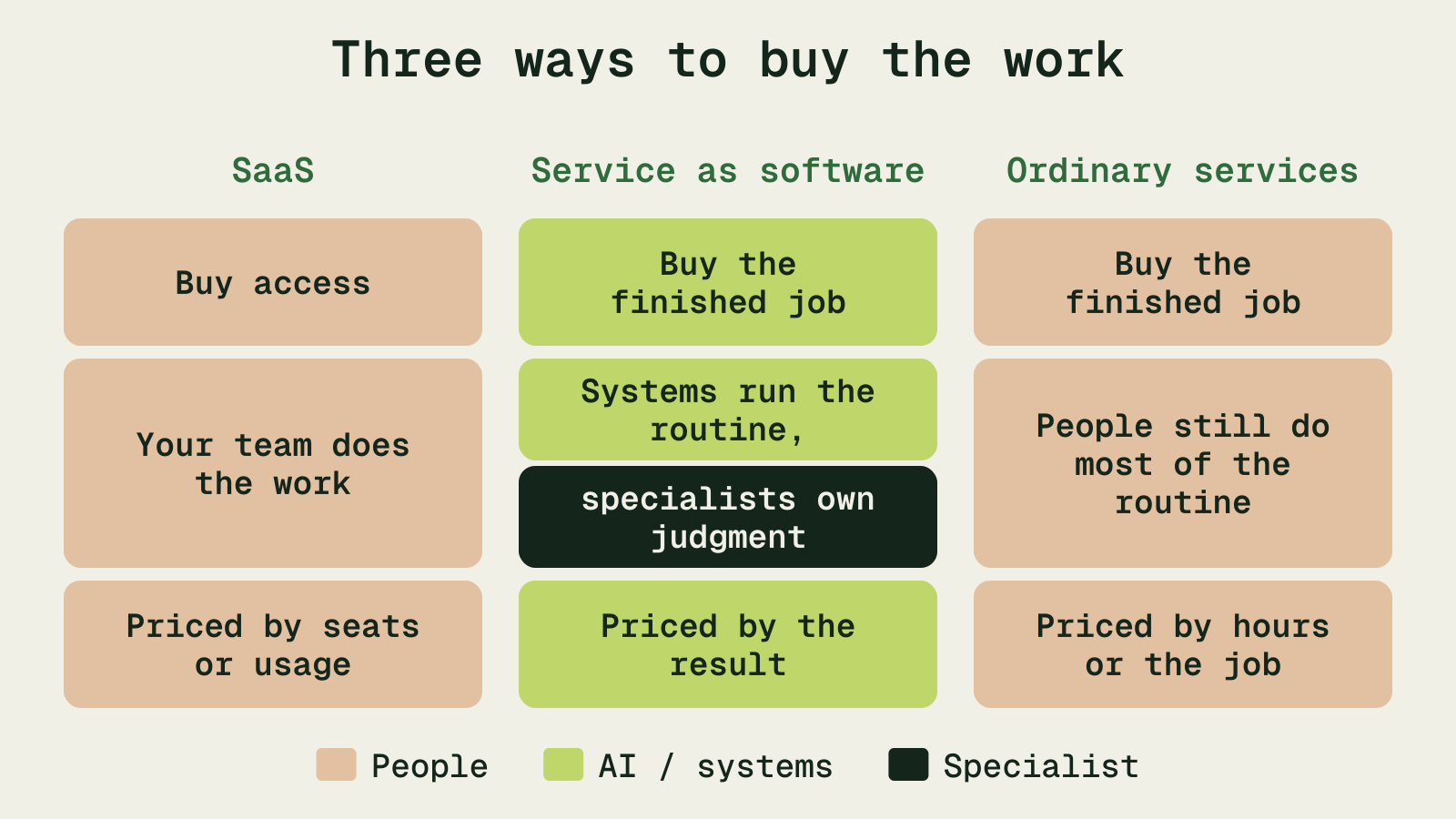
Service as software sells finished work that systems and specialists deliver. SaaS sells access to software your team still operates.
Service as software is a business model in which the customer buys finished work, and the provider uses software and AI to deliver most of it. SaaS is different: the customer buys access to software, and their own team still does the work inside it. The words sound alike. The product being sold is not.
What does service as software mean?
People search the phrase in a few spellings: service as software, services as software, Service-as-Software. They point at the same idea. The unit of sale is a completed job, not a login.
A buyer who needs invoices matched, claims checked or a month of books closed pays for that result. How much of the work a system runs, and where a person steps in, is the provider's operating model. The buyer is not meant to staff, configure and operate the software day to day.
That is the opposite of most business software. A SaaS product gives people screens, workflows and records. Someone on the buyer's side still has to do the job. The software helps. It does not take the job away.
We do not use "service as software" to describe our companies. We say AI-native services: finished work, AI on the routine, specialists on the judgment, priced by the result. The search phrase is useful because buyers and investors already use it. The category we build for is the same shift, named in our words.
How is service as software different from SaaS?
The difference is not hosting, and it is not whether AI appears in the product. Both models can live in the cloud and both can use AI. The difference is what the customer is buying and who is responsible for getting the work done.
- What you buy. SaaS: access to an application. Service as software: a defined result, carried out.
- Who does the work. SaaS: primarily the customer's team, using the software. Service as software: the provider's systems and specialists.
- How value is judged. SaaS: how well the product supports the team's work. Service as software: whether the agreed job was finished.
- How it is commonly priced. SaaS: seats, subscriptions or usage. Service as software: packages, completed tasks or verified results.
- What breaks first. SaaS: shelfware and unused seats. Service as software: a result that was not delivered.
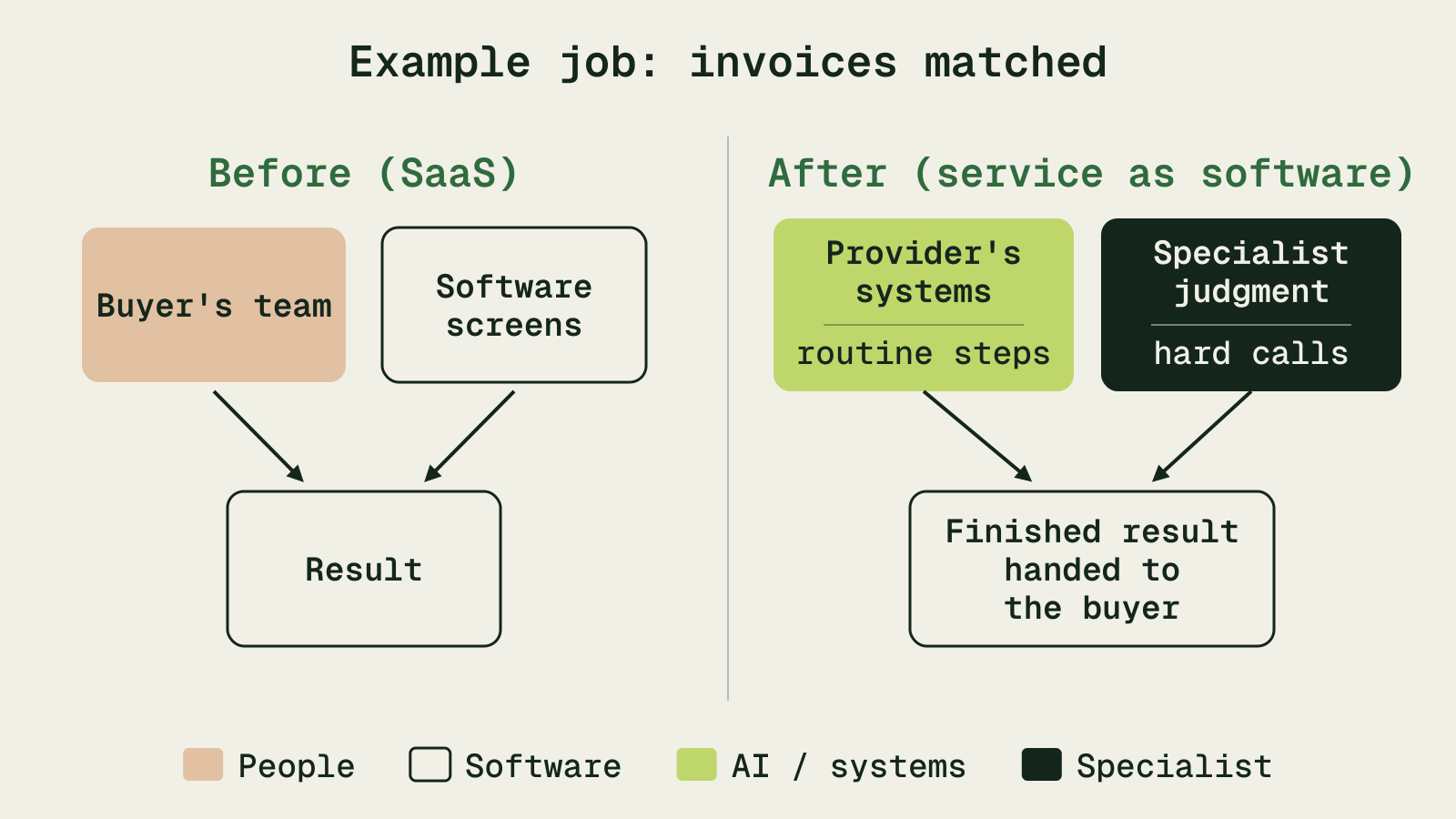
A product can look like SaaS on the surface and still sell work. A login, a dashboard and a monthly invoice do not settle the question. Ask who runs the routine steps and who stands behind the finished result. We wrote more on the pressure on seat-based software in Is SaaS dead because of AI?.
How is it different from ordinary services?
Ordinary services also sell finished work. An outside firm can close the books, process claims or handle invoices, and bill for the result or for the hours. The buyer is already paying for the job, not for software.
Service as software changes how that job is delivered. In a conventional services firm, people still do most of the routine. Software may help them move faster, but the cost of the next job stays close to the last one. In a service-as-software model, systems take the steps that repeat and follow clear rules. Specialists own the hard calls. Every judgment is captured and built back in, so the same kind of job needs less human time next time. That loop is what we describe in How does a data flywheel make each job cheaper in AI-native services?.
The market that matters is still the services budget. For every dollar spent on software, six are spent on services. Selling finished work reaches that budget. Selling software does not. We cover why that gap exists in Why do businesses spend more on services than on software?.
Why does the difference matter for pricing?
Because pricing has to match what is being sold.
If the product is access, seats and usage are natural meters. If the product is finished work, those meters drift away from value. A buyer who pays per seat while AI does more of the job is paying for people who no longer need to log in. A seller who bills by the hour while each job gets cheaper hands the gain to the buyer at every invoice.
Pricing by the result lines the meter up with the promise: pay when the agreed job is done and checked. That is outcome-based pricing. It fits service as software and AI-native services for the same reason. It fails when the result is vague, hard to count or mostly outside the seller's control.
What should buyers and investors check?
Labels move faster than delivery. A company can call itself service as software and still be selling seats, or still be running the old services model with a chatbot on top. Useful checks:
- Is the unit of sale a result or access? If the contract is mostly seats, it is still SaaS dressed up.
- Who runs the routine? If the buyer's team still does the repeating steps, the software is a tool, not a service.
- Who owns judgment? Hard, ambiguous or costly cases need a named specialist path, not a confident answer from a model.
- Does the same job get cheaper over time? If human time behind a mature customer stays flat, the model is not compounding.
- Is the price tied to the result? Hourly and seat pricing give the efficiency away; result pricing keeps it where it can fund the next improvement.
At the lab, we build, invest in and acquire AI businesses that sell finished work this way. We call them AI-native services companies. The search phrase is a map to the same idea.
Questions people ask
Is service as software the same as services as software?
Yes. Buyers and writers use both spellings, and Service-as-Software as a label. They all mean selling finished work delivered with software and AI, rather than selling access to software the customer operates.
Is service as software the same as SaaS?
No. SaaS sells access to an application your team uses. Service as software sells a completed job the provider delivers. Both can be cloud software. What changes is who does the work and what the bill is for.
Is service as software just outsourcing with AI?
Not if the delivery is rebuilt. Ordinary outsourcing still has people doing most of the routine. Service as software puts systems on that routine, keeps specialists on judgment, and uses each job to make the next one cheaper. Adding a chatbot to an unchanged services firm is not the same thing.
What are examples of service as software?
Examples are offers that sell a checked result rather than a seat: matched invoices, processed claims, closed books, resolved support cases. The test is whether the customer buys the finished job and the provider runs the work behind it.
Why do you say AI-native services instead of service as software?
Service as software is a phrase people search. AI-native services is how we name the structure we build for: sell finished work, put AI on the routine, keep specialists on judgment, capture every judgment, and price by the result so each job lowers the cost of the next.
Questions or ideas? Email hello@skywakelabs.com.
Buyers, investors and partners: hello@skywakelabs.com
More notes
What is agentic BPO?
Outsourcing where AI agents work most cases and specialists take the exceptions. Real agentic BPO prices the finished case, not seats or agents.
ReadWill AI replace procurement teams?
Not the team. AI takes the paperwork of buying; people keep the decisions with no written answer: which supplier, on what terms and whether to buy at all.
Read