Why do businesses spend more on services than on software?
Because software only helps people do the work, while services pay for the work itself: the time, checks and judgment behind every job.
Because software was only ever sold to help people do the work, and the work is what a business actually needs done. Sequoia estimates businesses spend about six dollars on services for every dollar on software. Software made the routine steps faster, but the exceptions, checks and judgment calls behind each job stayed with people, and that time is what the services budget pays for.
What does a business actually pay for when it buys services?
A business that buys services is not buying access to anything. It is buying a finished job: a batch of claims processed, a month of supplier invoices matched and paid, a set of books closed. The software involved is one input to that job. The rest is people: reading what came in, spotting what doesn't fit, checking it against the rules, deciding what to do and standing behind the result.
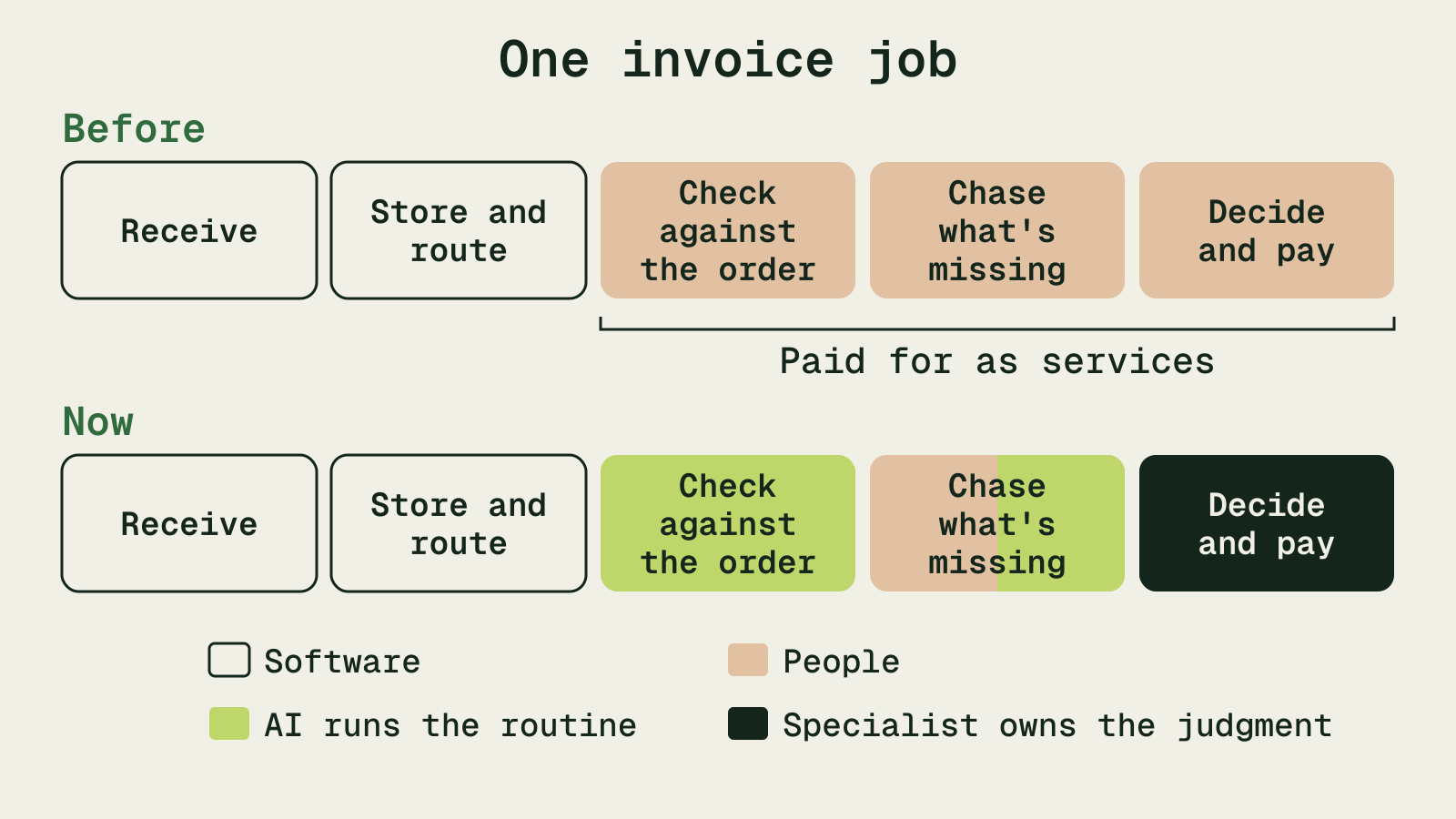
Take a single supplier invoice. The software stores it, routes it and records the payment. A person still has to work out why the amount doesn't match the purchase order, chase the missing detail and decide whether to pay. In our view, that second part is where most of the effort in the job sits, and when a business sends the work to an outside firm, it is paid for as services.
Why didn't software ever take over that budget?
Software is good at work that follows clear rules every time. Many jobs don't. They follow the rules most of the time and break them in ways no one wrote down in advance: a claim with a missing document, an invoice in the wrong currency, a contract term that changes what a payment should be. Each of those cases needed a person, so software could speed up the steps around the work without doing the work itself.
Two more things kept the budgets apart:
- Software sold by the seat is capped by headcount. A seat typically costs the same whether its user handles a hundred cases a month or ten thousand. The services budget has no such cap. It grows with every claim, invoice and case that has to be handled.
- Software creates work around itself. Someone has to set it up, connect it to other systems, keep its records clean and deal with whatever it can't handle. Much of that is services too.
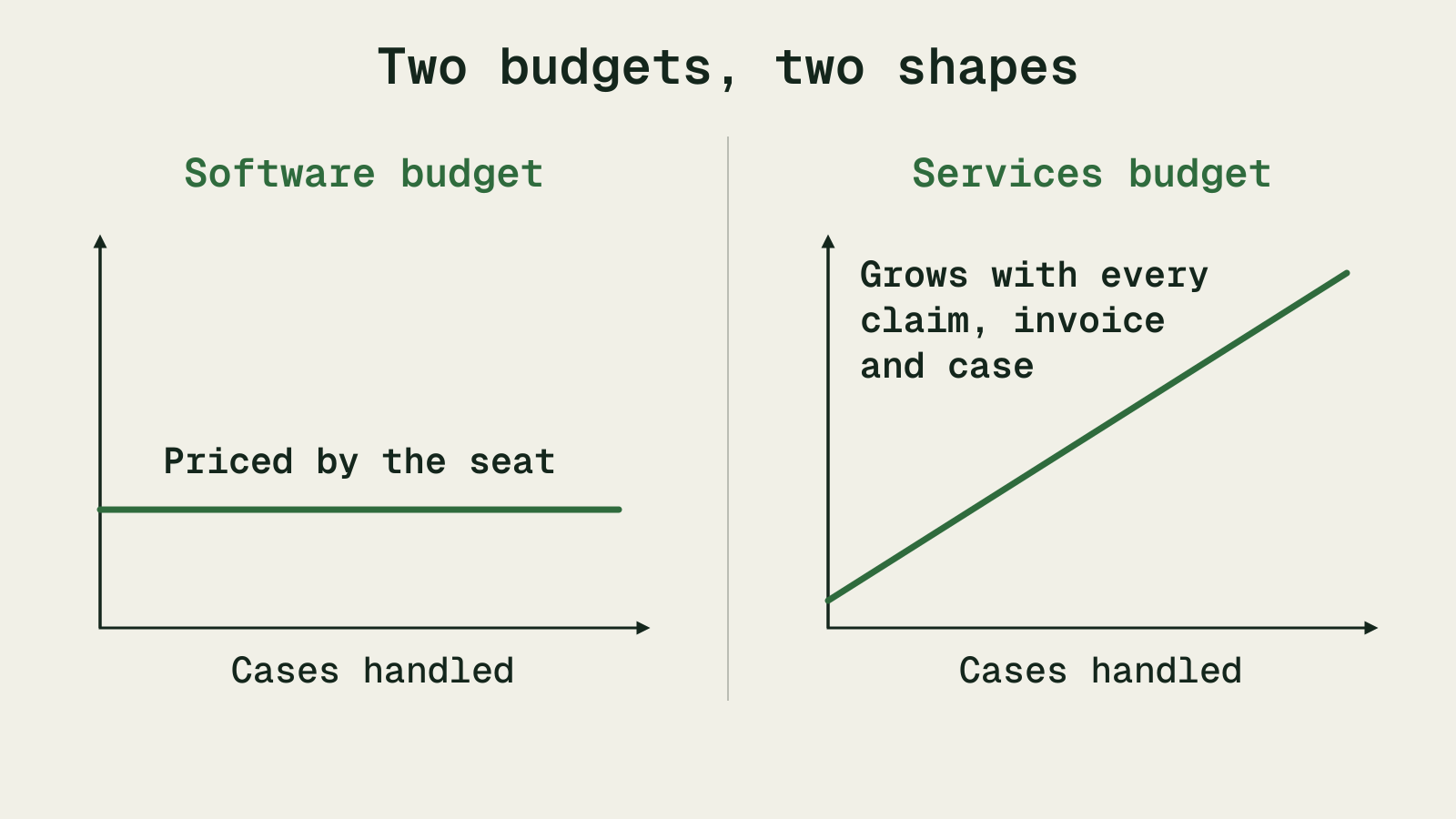
Software, in other words, was priced as a share of the time it saved the person using it. The person's time stayed the larger bill.
Why does the gap matter now that AI can do part of the work?
Because AI reaches into the part software couldn't. It can read an unstructured document, compare it with a record, draft a response and flag what doesn't fit. That moves the line between what a system runs and what needs a person, and this time the line moves inside the work itself, not around it.
That opens the services budget to companies that deliver the finished job, as we explain in What is an AI-native services company?
Will cheaper work make the services budget smaller?
Not necessarily. When the work gets cheaper, two things can happen to the budget behind it.
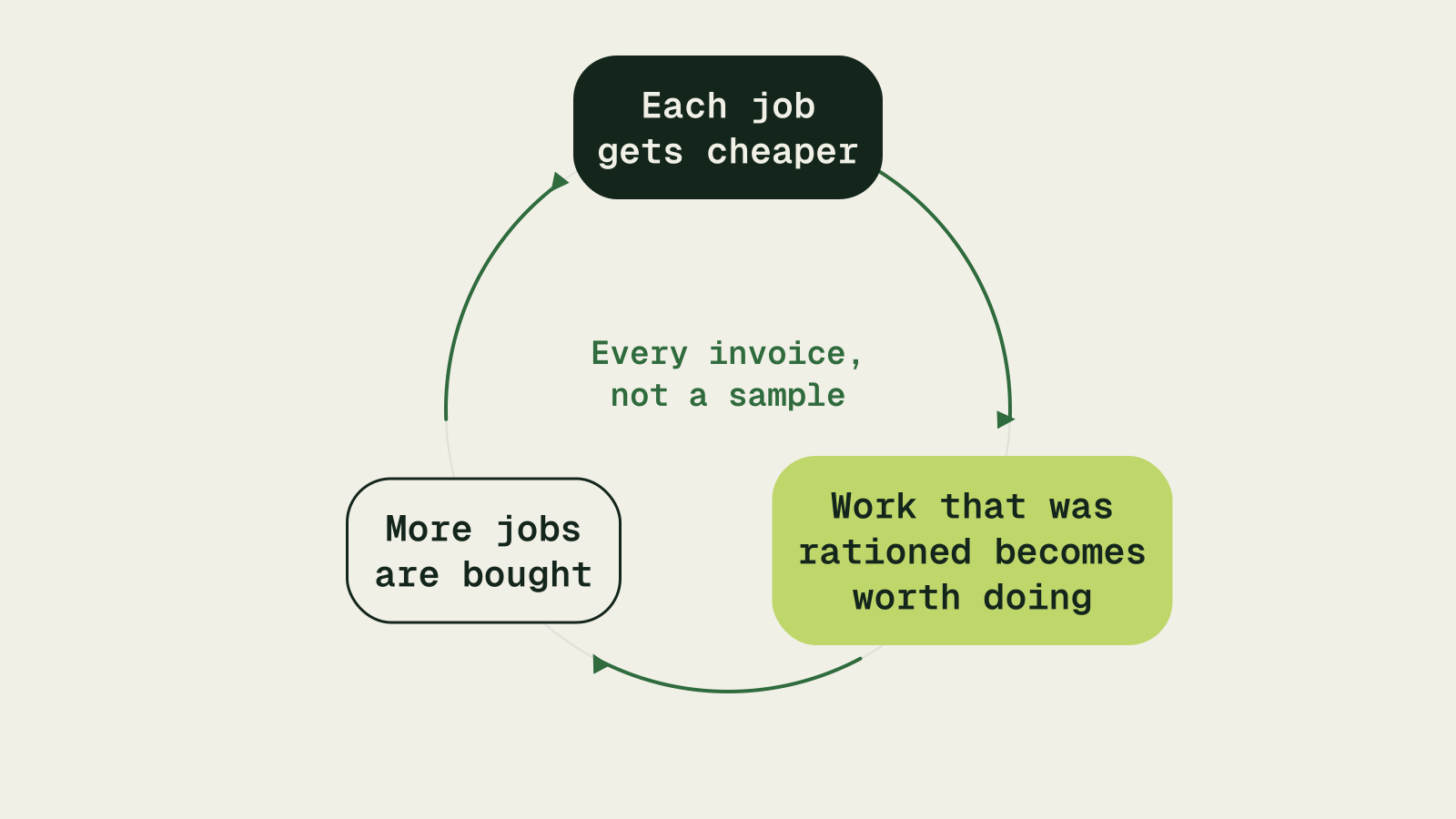
- The price of each job falls. Billed by the hour, that gain goes to the buyer; priced by the result, it stays with the business doing the work.
- The amount of work bought can rise. Work that was too costly to do properly becomes worth doing: checking every invoice instead of a sample, reviewing every claim instead of only the large ones, following up on every small overdue balance.
In our view, the second effect is the one to watch. Work that businesses ration because each case needs a person's time is work they are likely to buy more of once it doesn't. The services budget may not shrink as the work gets cheaper. It may be spread across many more jobs.
What should buyers and investors take from the gap?
For buyers, the biggest savings from AI are unlikely to show up on the software line. They sit in the services lines: the outside firms and the hours spent on work that repeats. The useful question is which of those jobs could be bought as a finished result, at a known price.
For investors, the gap changes how to size an opportunity. A company that sells software to the people doing a job competes for the software budget for that job. A company that delivers the job competes for the work budget behind it, which is the larger of the two. The test is whether the company really does the work, and whether the human time behind each job keeps falling. We judge a business by how fast the work gets cheaper.
Questions people ask
Is the services market bigger than the software market?
Yes. Sequoia estimates businesses spend about six dollars on services for every dollar on software. Software gets more attention, but the work it supports has long been the larger bill.
What counts as services spending?
Money a business pays to have work done for it, such as outside firms that process claims, keep the books, collect overdue payments or run IT. It pays for the work and the people behind it, not for access to an application.
Will AI reduce how much businesses spend on services?
The price of each job is likely to fall. Whether total spending falls depends on how much more work businesses buy once it is cheaper, since some work is rationed today because each case needs a person.
How should a business choose between buying a tool and buying the finished work?
Start with the job, not the tool: how many cases it handles each month, how many of them break the rules, and how much staff time those exceptions take. If most of the cost sits in that time, buying the finished work at a known price is likely to save more than another license. Before signing, check what counts as a finished job, who owns the errors, and whether the price follows the result.
Questions or ideas? Email hello@skywakelabs.com.
Buyers, investors and partners: hello@skywakelabs.com
More notes
What is agentic BPO?
Outsourcing where AI agents work most cases and specialists take the exceptions. Real agentic BPO prices the finished case, not seats or agents.
ReadWill AI replace procurement teams?
Not the team. AI takes the paperwork of buying; people keep the decisions with no written answer: which supplier, on what terms and whether to buy at all.
Read