How do you build an AI-native services company?
Start from work buyers already pay for, rebuild delivery around AI on the routine and specialists on judgment, and price by the result so each job gets cheaper.
You build an AI-native services company by starting from work businesses already pay someone to finish, rebuilding how that work is delivered around AI and specialists, and pricing the finished result so each job costs less than the last. AI runs the steps that repeat. Specialists own the judgment. Every hard call is captured and built back in.
We defined the category in What is an AI-native services company?. This note is the build path: how a company like that gets from a blank page to compounding delivery.
What kind of work is worth building around?
Not every services market fits. The work has to pass four tests.
- Someone already pays for the finished job. You are displacing a vendor or an internal team that already has a budget, not inventing a new habit. Matched invoices, processed claims and closed books sit in budgets today.
- Jobs repeat and customers look alike. If every job is a one-off, nothing learned on the last one carries to the next. Similar customers and repeating jobs are what make a data flywheel possible.
- Most steps are routine; a few need judgment. Break the job into pieces. If every piece needs a person making a real call, you cannot scale. If almost none do, pure software may win. The sweet spot is routine volume with concentrated hard cases.
- You can name the unit you will sell. A discrete, countable result with a known labor cost behind it is easier to price and prove than a vague improvement. We cover that meter in What is outcome-based pricing?.
The market that matters is still the services budget. For every dollar spent on software, six are spent on services. Building for finished work reaches that budget.
How do you turn that work into a company?
At the lab we use five steps, whether we build, back or acquire the company. The route can differ. The operating model does not.
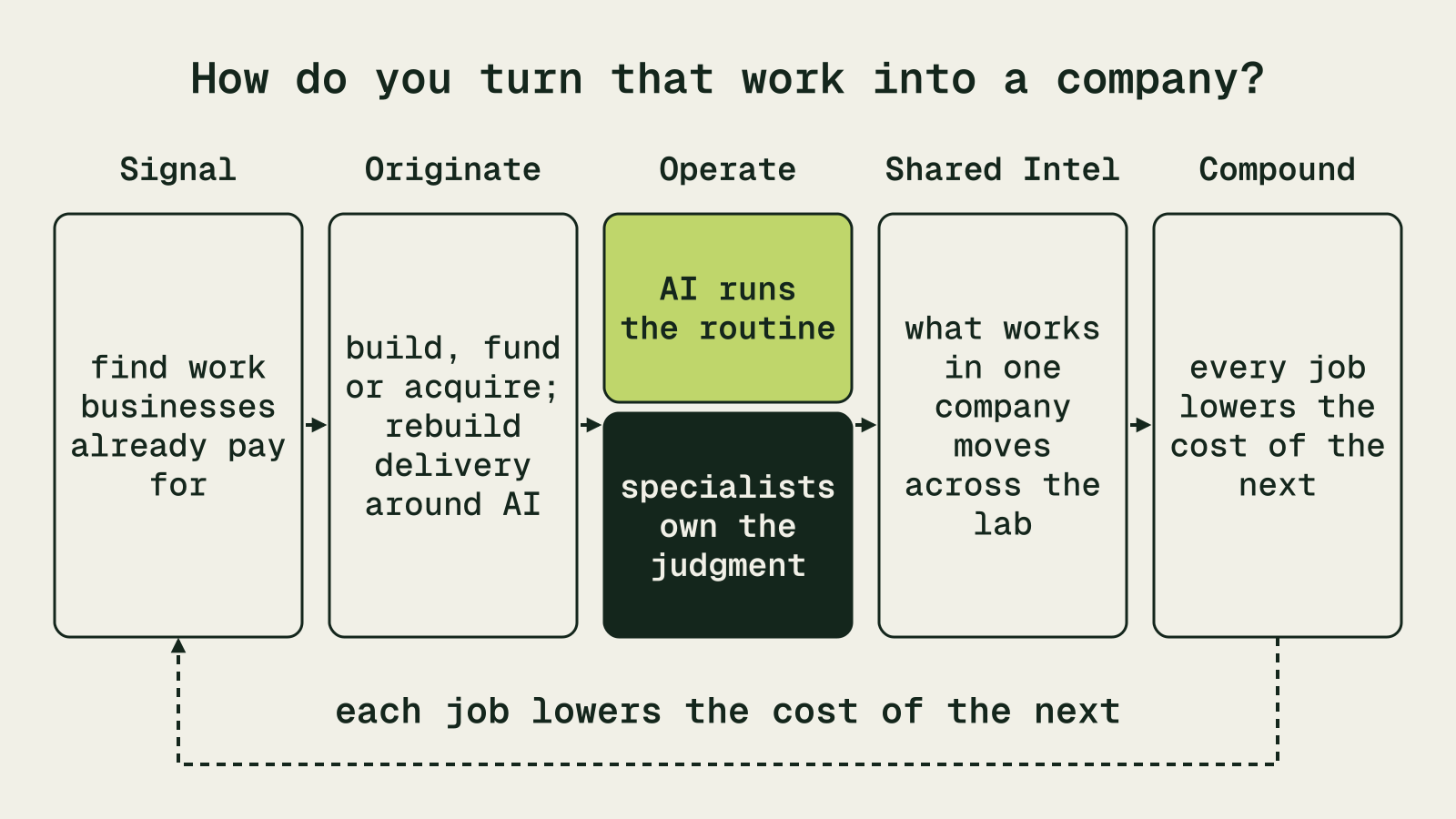
- Signal. Identify work businesses already pay for, where jobs repeat, customers are alike and AI can deliver a finished result. Start from money already being spent, not from what a model can demo.
- Originate. Build, fund or acquire the company that will deliver that work, and rebuild its operations around AI from day one. Every route leads to the same end: finished work, priced by the result.
- Operate. Split each job into the steps a system can run and the decisions that need a person. AI executes the routine. Specialists own the judgment. Every judgment is captured with its reason and built back in, so the next similar job does not pay for the same judgment again.
- Shared Intel. What works in one company moves across the lab. Playbooks, systems and captured judgments are open to every other company, so a fix proven once is used everywhere and each new company starts ahead of the last.
- Compound. Every job lowers the cost of the next. Expand first to new customers for the same work, then to new work for existing customers. Because the price is tied to the result, not the hour, the gain stays in the business and funds each step outward.
The same five steps hold whether the company is created or rebuilt. What matters is that delivery, learning and pricing are designed together from the start.
How should delivery be designed from day one?
Delivery is the product.
Design the job as a path, not as a chat. Routine steps — intake, matching, categorizing, status updates, drafts that follow a fixed rule — belong to systems. Ambiguous, costly or irreversible decisions belong to named specialists. The handoff is part of the design, not an apology when the model fails.
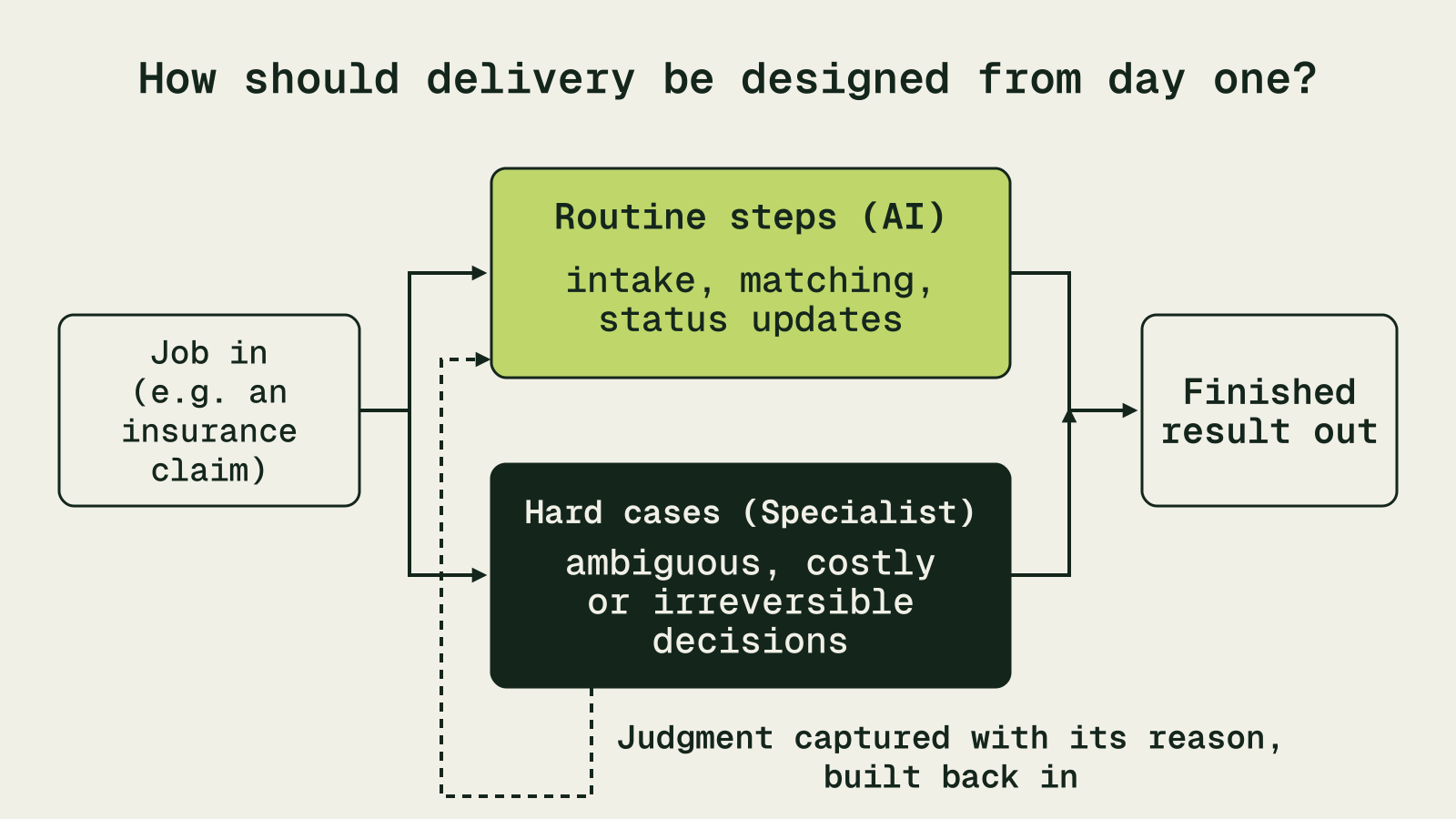
Capture every specialist judgment with the reason behind it. That record is how the next similar job needs less human time. Without it, you have an ordinary services firm with a chatbot on top, and the cost of the next job stays flat. With it, you get the loop we describe in How does a data flywheel make each job cheaper in AI-native services?.
Measure what an operations team would measure: throughput, cycle time, exception rate, rework and cost of human time per finished unit. Active users and seats are the wrong scoreboard for a company that sells completed work.
Be honest about why a person is still in the loop. If they are there because the work genuinely needs judgment, keep them and design for them. If they are there to paper over a product gap, fix the gap. People papering over a gap are not a moat.
How should the company be priced?
Price the verified result, not the inputs.
Hourly pricing punishes getting faster: a job that takes less time produces a smaller bill. Seat pricing charges for access while AI does more of the work and fewer people need to log in. Usage pricing charges for activity, including activity that fails. Outcome-based pricing charges when an agreed result is delivered and checked. The seller carries the cost of learning and of failed attempts. The buyer pays for finished work.
That only works when the unit is clear enough that two reasonable people would agree it happened: a matched invoice, a processed claim, a month of books closed. Prefer a hard, countable unit with a measurement window and written exclusions.
How does the company grow without resetting the cost curve?
Growth that resets the cost of delivery is not compounding. Growth that reuses what the company already learned is.
First, win more customers who look like the ones you already serve. Similar jobs transfer. Dissimilar ones do not. Then, sell adjacent work to customers who already trust the finished result. Shared systems and shared judgments make the second product cheaper to stand up than the first.
Inside a venture lab, that transfer is deliberate. Anyone can rent the same models. The playbooks and captured judgments are what make each new company start ahead of the last.
Questions people ask
What is the first step in building an AI-native services company?
Find work buyers already pay to have finished, with repeating jobs, similar customers and a clear split between routine steps and judgment.
Do you have to build the company from scratch?
No. You can build new, back a team already doing the work, or acquire a services business and rebuild its delivery. The operating model must be in place from day one.
How is this different from adding AI to an ordinary services firm?
Adding AI to the old way of working usually cuts cost once. Rebuilding the job, capturing every judgment and pricing by the result keeps human time per job falling.
Should the company sell software or finished work?
Finished work. Software leaves the buyer running the job; finished work puts the provider on the result.
Where do specialists fit if AI does the routine?
On the judgment calls: exceptions, ambiguous cases and costly decisions. Specialists are not a temporary patch. They are how the company learns.
Questions or ideas? Email hello@skywakelabs.com.
Buyers, investors and partners: hello@skywakelabs.com
More notes
What is agentic BPO?
Outsourcing where AI agents work most cases and specialists take the exceptions. Real agentic BPO prices the finished case, not seats or agents.
ReadWill AI replace procurement teams?
Not the team. AI takes the paperwork of buying; people keep the decisions with no written answer: which supplier, on what terms and whether to buy at all.
Read