Can AI run accounts receivable and collections?
Much of it: AI can check, send and match invoices and build dispute files, while credit, concessions, payment plans and write-offs stay with people.
AI can run much of it: checking invoices before they go out, matching incoming payments to the invoices they cover, answering the reason a payment is late and building the file behind each dispute. Decisions about the customer stay with people: who gets credit, which concessions to make, when to agree to a payment plan and when to write a balance off. In our view, the bigger gain sits upstream, because many late payments start with an invoice the customer could not process.
Why is a late payment often an invoicing problem?
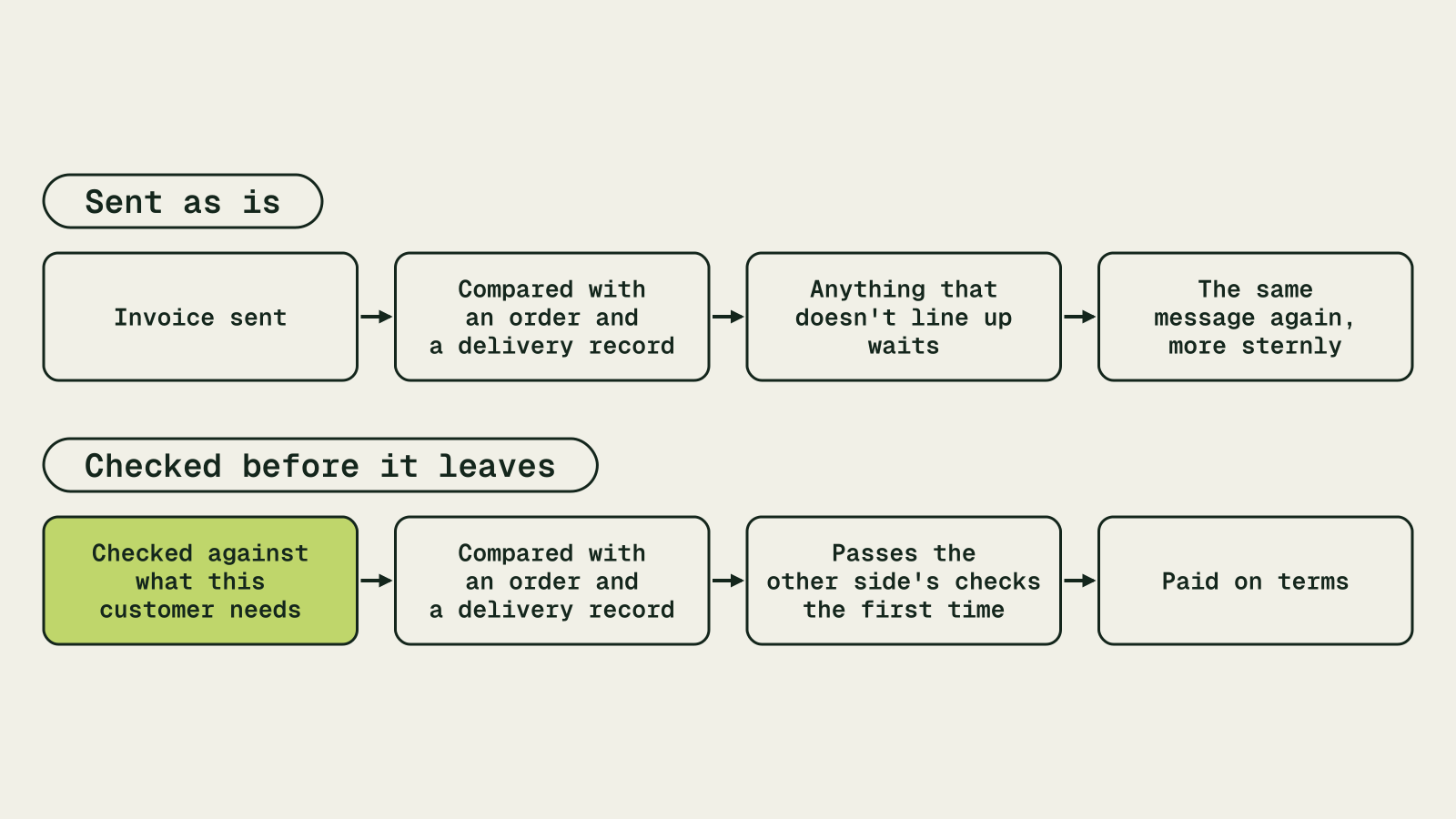
From the outside, a past-due invoice looks like a customer who hasn't paid. Inside the customer's business it often looks different: an invoice their payables team could not push through. Their process compares each invoice with an order and a delivery record, and anything that doesn't line up waits.
So your invoice is someone else's exception. The causes are mundane: an order number left off, a price that doesn't match the agreed rate, a delivery with no proof attached, an invoice addressed to the wrong company or sent to the wrong portal. Sending the same message again, more sternly, changes nothing about why it is stuck. Someone has to find the gap and send a version the customer can pay.
We look at the same checks from the payer's side in Can AI take over accounts payable? Receivables is the mirror image. The work is to make every invoice pass the other side's checks the first time. This note is about invoices between businesses.
What receivables work can AI take on?
The work that suits AI has a result someone can check: the invoice was accepted, the payment matches, the file is complete.
- Getting invoices accepted. Before an invoice leaves, AI can test it against what this customer needs: the order number, the agreed price, the right legal entity, the documents their portal insists on. It then sends the invoice where the customer wants it and confirms it arrived.
- Matching payments to invoices. One transfer can cover many invoices or only part of one, and the details of what it covers often arrive in a separate email. Reading those details and tying each payment to what it covers is repeat work with a right answer.
- Answering the reason, not the date. A reminder only helps a customer who simply forgot. When the customer writes back, AI can work out what is actually holding the invoice and answer that: a reissued invoice with the missing order number, a copy of the delivery record, the price both sides agreed.
- Building dispute and deduction files. When a customer pays short or questions a charge, AI can gather the contract terms, the order, the delivery record and the message history, and set out whether the claim fits the agreement.
For a routine invoice, that covers the path from sent to paid. For a stuck one, it covers the digging, so a person starts from the facts instead of a search.
Which decisions about the customer should stay with people?
Receivables is where finance meets the customer relationship, and the decisions that matter are about the relationship as much as the ledger.
Extending credit, or continuing to ship to a customer who is falling behind, weighs what the account is worth over years against the risk on the books today. Accepting a deduction the agreement doesn't clearly cover is often a commercial choice, not a matching one: a small concession can be worth more than the argument. Agreeing to a payment plan, writing off a balance or passing an account to an outside collection firm each change how that customer sees the business.
AI should prepare every one of these with the facts in view: the account's history, what the agreement says, what was promised and what was kept. A person who knows the customer should decide, with the reason recorded. The general version of this split is in Human in the loop vs human on the loop.
How does each stuck invoice make the next one easier to collect?
This is where AI-run receivables can pull away from a team working a queue. Every stalled invoice has a reason. When that reason is recorded each time, patterns show up: one customer always wants its contract reference on the invoice, another sends back anything addressed to its head office, a rate in the billing system was never updated.
Each pattern becomes a rule the next invoice follows before it leaves. Fix it once, and later invoices to that customer should clear their checks without a chase. Over the months the follow-up work shrinks, not because reminders got faster, but because fewer invoices need one. It is the same compounding we describe in How does a data flywheel make each job cheaper in AI-native services?
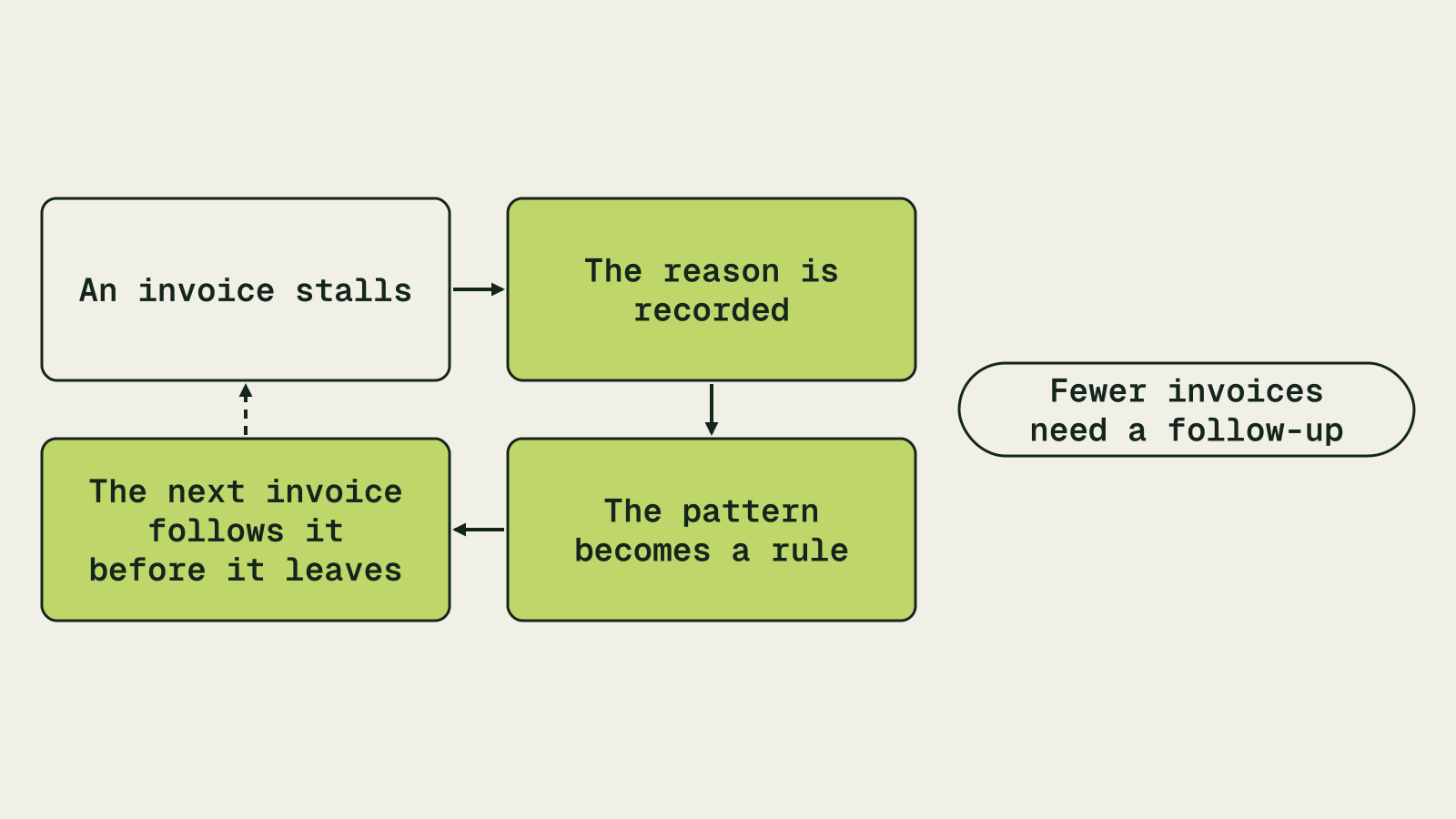
A team that only works the past-due list misses this. It closes the same kinds of items every month, and the cost of collecting a dollar stays flat.
What should a buyer measure when AI runs receivables?
Buying receivables as finished work means paying for results: invoices settled and cash collected, not reminders sent or hours logged. We explain the model in What is outcome-based pricing?
Be careful with a price tied only to dollars collected. It can reward pressure on customers, and receivables done badly costs goodwill long after the invoice is paid. Track how the work is done as well:
- the share of invoices paid on terms with no follow-up at all
- how long a disputed invoice takes to settle, from first notice to closed
- how often customers push back on the follow-up they receive
- whether fewer invoices need a person each quarter
The first and the last matter most. Together they show whether the work is getting cheaper or just getting done.
Questions people ask
Will AI replace accounts receivable jobs?
In our view, AI takes over much of the matching, sending and routine follow-up. Receivables roles shift toward the work that needs judgment: settling disputes, managing credit and keeping important customer relationships in good shape.
Can AI handle cash application?
Yes, for most payments. A payment either ties to open invoices by amount and reference or it doesn't, so the result can be checked. Where the details are missing or the sums disagree, the system lays out its likeliest matches and a person chooses.
Should AI decide which customer deductions to accept?
Only where the agreement settles it. If a customer takes a discount or rebate the contract plainly allows, the system can clear it. Anything outside that should reach a person with the evidence attached, since accepting or contesting it is a commercial choice.
Is AI in collections the same as using a collection firm?
No. An outside collection firm usually steps in once a balance is well overdue, often after the relationship has already suffered. AI in receivables works from the day the invoice is sent, with the aim of keeping accounts from reaching that point.
Questions or ideas? Email hello@skywakelabs.com.
Buyers, investors and partners: hello@skywakelabs.com
More notes
What is agentic BPO?
Outsourcing where AI agents work most cases and specialists take the exceptions. Real agentic BPO prices the finished case, not seats or agents.
ReadWill AI replace procurement teams?
Not the team. AI takes the paperwork of buying; people keep the decisions with no written answer: which supplier, on what terms and whether to buy at all.
Read