What work should stay with humans in AI claims processing?
AI should build the claim file and run simple claims. People should own unusual coverage calls, disputed values, denials and fraud referrals.
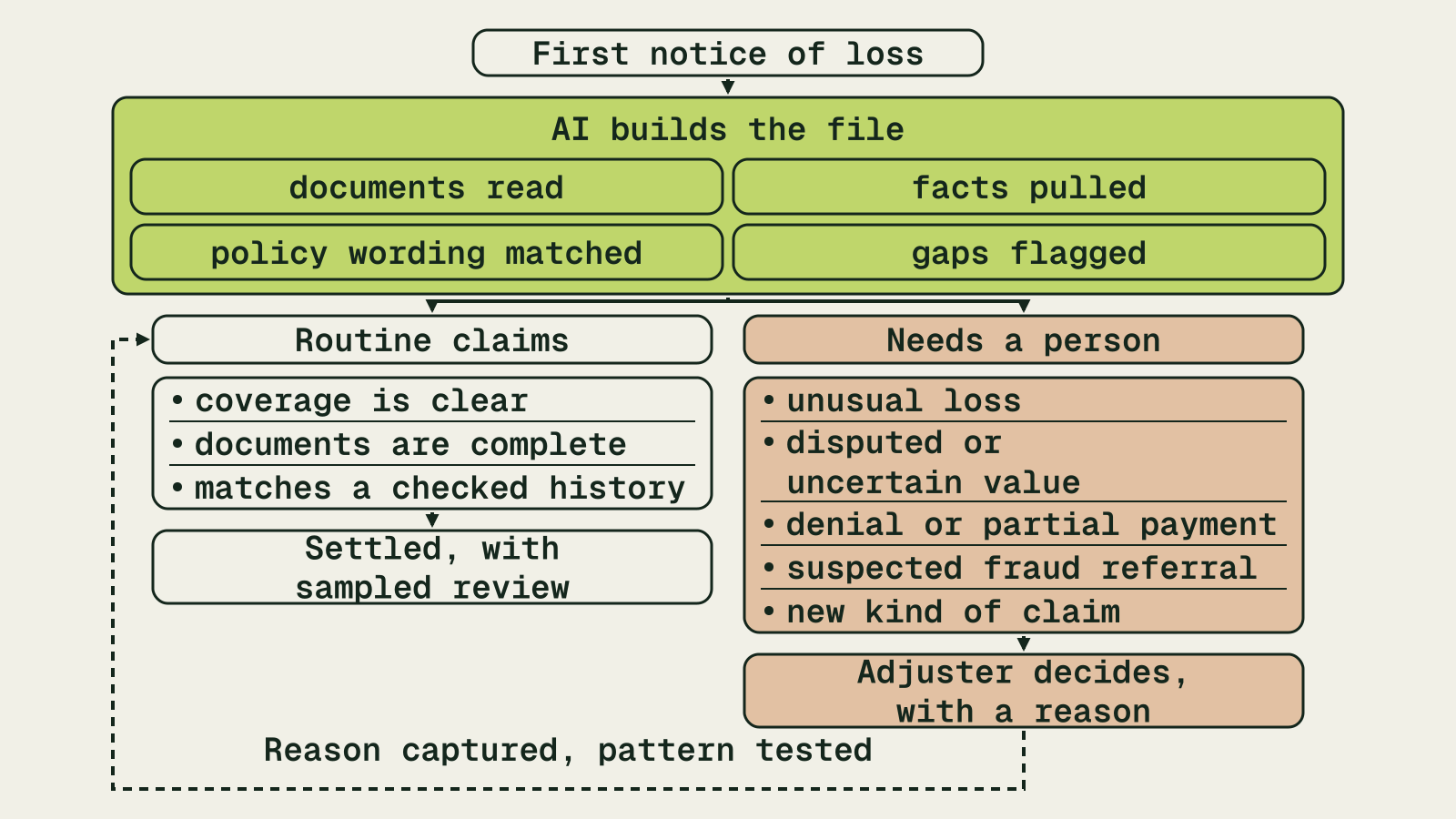
In AI claims processing, AI should get the file ready and run the simple claims. People should own the decisions that turn on meaning rather than matching: coverage on an unusual loss, a disputed value, a denial, a suspected fraud referral and any new kind of claim. The test of a good setup is whether the adjuster sees the evidence behind the AI's draft, not just the draft.
Where does AI help most in claims processing?
Before anyone decides a claim, someone has to build the file. That means reading the first notice of loss, the photos, the repair estimates, the prior claims and the policy itself, then pulling out the facts that matter and putting them in order. On most desks, this assembly takes more time than the decision it feeds.
This is where AI earns its place first. It can read every document in the file, pull out dates, parties and amounts, match the loss to the relevant policy wording, build a timeline and flag what doesn't fit: a missing estimate, an invoice that doesn't match the photos, a date that conflicts with the first report.
Getting a file ready for a decision is different from making the decision. A well-built file makes the adjuster's call faster and better. A system that skips straight to an answer hides the file behind a conclusion.
Which claims can run as routine?
Some claims really are routine. Coverage is clear, the documents are complete, the amount is small and the claim looks like many earlier ones that were checked and settled without trouble. A simple glass claim with a matching repair invoice is a typical example.
Claims like these can run end to end with sampled review: a person checks a share of them after the fact, and the system's share grows only as those checks hold up. Routine status is earned case type by case type, from a verified history, not granted because a model sounds sure of itself. We describe how each captured decision makes the next job cheaper in How does a data flywheel make each job cheaper in AI-native services?.
Which claim decisions should a person own?
The general rule for which decisions need a person is in Human in the loop vs human on the loop. In claims, it comes down to five kinds of call.
- Coverage on an unusual loss. When the answer depends on an exclusion, an ambiguous clause or a loss the policy wording didn't anticipate, the call needs someone who reads the policy, not a pattern match.
- A disputed or uncertain value. Conflicting estimates, hidden damage or a claimant who disagrees with the number all need a person to weigh the evidence and set the value.
- A denial or a partial payment. A "no" is the decision a claimant feels most. AI can draft the reasons and cite the documents, but a person should make that call after reading the file.
- A suspected fraud referral. A flag is a reason to look closer, not a finding. A person decides whether the pattern means anything before the claim is treated differently.
- A new kind of claim. A loss that matches nothing in the verified history goes to a person, however routine it looks on the surface.
Explaining a hard decision to a claimant also stays with a person. The facts can be drafted. The judgment about how to say them can't.
How do you keep adjuster review from becoming a formality?
A review step is only real if the adjuster sees the evidence behind the AI's draft and has room to reach a different answer. That depends on how the review is designed, not on whether a review step exists.
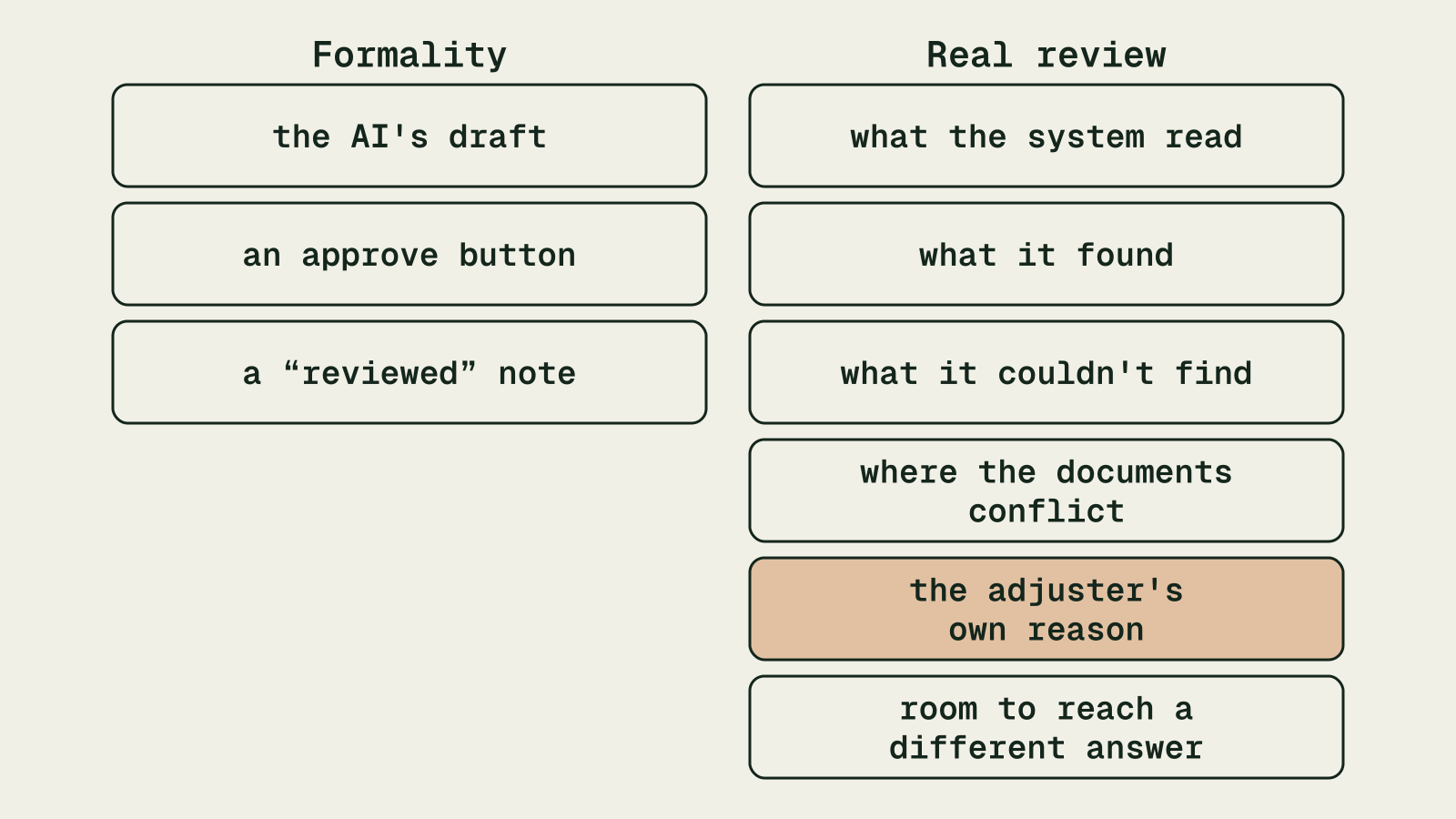
- Show the evidence, not just the draft. The adjuster should see what the system read, what it found, what it couldn't find and where the documents conflict. A conclusion with an approve button invites agreement.
- Ask for the adjuster's own reason. A note that says "reviewed" adds nothing. A sentence on why the call was made is what makes the decision real, and it is what the system learns from.
- Route by history, not confidence. A draft sounds equally fluent when it is right and when it is wrong. Claims that resemble a long, checked history can move faster. Claims that resemble nothing, or resemble cases that often went wrong, go to a person.
- Agree the routing rules before the system is switched on. Decide in advance which claim types always go to a person, the value above which a senior adjuster signs off, and who can pause the system if its output goes wrong.
How does the split change over time?
The line between routine and judgment moves. Each adjuster decision, captured with its reason, becomes evidence. Once a kind of claim has a clear, tested pattern, it can join the routine side, and the adjuster's time moves to harder files.
Two things keep that movement honest. First, new kinds of loss keep arriving, and those stay with a person. Second, adjusters still need simple, well-documented claims to learn on. If AI takes every simple claim, new adjusters never build the judgment the hard claims need, a problem we explore for another profession in Will AI replace accountants?.
The goal isn't fewer people on claims. It is each claim needing less of a person's time on the parts that don't need them, and more of it on the parts that do.
Questions people ask
Can AI approve insurance claims on its own?
It can settle simple claims where coverage is clear, the documents are complete and the claim matches a long, checked history. Those claims should still be sampled after the fact, and anything unusual, disputed or new should go to an adjuster.
Should AI deny insurance claims?
No. AI can assemble the evidence and draft the reasons, but a denial or partial payment is the decision a claimant feels most, and a person should make it after reading the file.
What is touchless claims processing?
Touchless claims processing means a claim moves from first notice to payment without a person handling it. It suits simple, well-documented claims, and it works best when the touchless share is earned from checked results rather than set as a target.
What parts of claims processing can AI automate?
AI handles the assembly work well: reading documents, pulling out facts, matching the loss to policy wording, building a timeline and flagging gaps or conflicts. It can also run simple claims end to end once their pattern is proven.
Questions or ideas? Email hello@skywakelabs.com.
Buyers, investors and partners: hello@skywakelabs.com
More notes
What is agentic BPO?
Outsourcing where AI agents work most cases and specialists take the exceptions. Real agentic BPO prices the finished case, not seats or agents.
ReadWill AI replace procurement teams?
Not the team. AI takes the paperwork of buying; people keep the decisions with no written answer: which supplier, on what terms and whether to buy at all.
Read