What is an AI-native insurance brokerage?
A brokerage built so AI runs the paperwork behind each policy and brokers own the advice. Its edge: smaller accounts can become worth serving well.
An AI-native insurance brokerage is a brokerage whose delivery is built around AI from the start. Systems run the paperwork behind each policy, from gathering the client's details to preparing applications, comparing quotes and getting renewals ready, while brokers own the advice, the conversations with insurers and the decisions. What makes it a different business, not just a faster one, is the cost to serve each account: when that cost keeps falling, accounts that were too small to serve well can become worth serving.
Why does insurance brokerage suit an AI-native model?
Three things about brokerage make it a natural fit.
- It already sells finished work. A client doesn't pay a broker for hours. Brokers are usually paid a share of the premium on the coverage they place, sometimes with a fee on top. When the work behind a policy gets faster, the gain stays in the business instead of shrinking the bill, which is the logic we explain in What is outcome-based pricing?.
- The work repeats. The same kinds of business get asked the same questions by the same insurers, and every policy comes back for renewal. Repeat work is where every lesson from one account carries over to the next.
- Much of it can be checked. Does the application match the client's records? Does the issued policy match the terms that were agreed? Questions with a clear right answer are the ones a system can take on safely.
What does AI run and what do brokers own?
Think of a policy's life as a file that moves from first contact to renewal. Much of the effort along the way is assembly and checking. The rest is the advice that clients actually come to a broker for.
AI runs the paperwork:
- Building the client file from what arrives: prior policies, loss history, property and vehicle lists, payroll figures.
- Filling in applications and each insurer's questionnaire, and chasing whatever is missing.
- Lining up the quotes that come back and marking where their limits, exclusions and terms differ.
- Checking the issued policy against what was agreed, and drafting routine paperwork such as standard certificates.
- Pulling next year's renewal file together well before the date, with what changed in the client's business flagged.
Brokers own the judgment:
- Understanding how the client's business actually runs and where its real risks sit.
- Recommending the coverage, the limits and which quote to take.
- Picking the insurers most likely to take on a hard risk, and making the case to them.
- Negotiating terms, and pressing the client's side when a claim is disputed.
- The relationship itself, which is why clients stay.
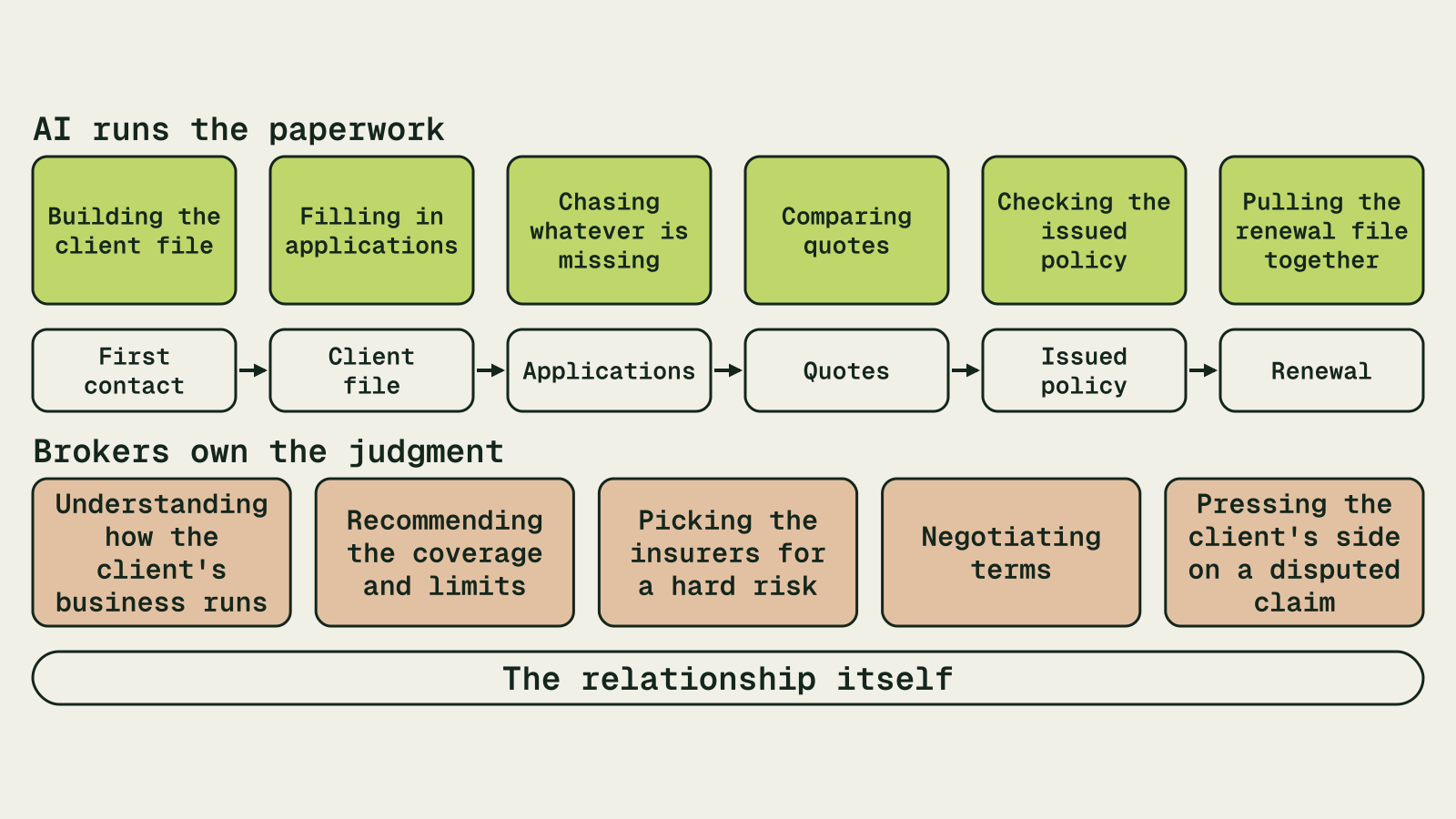
AI executes the routine. Specialists own the judgment. For more on which decisions a person should own before anything goes out, see Human in the loop vs human on the loop.
Why does it matter most for smaller accounts?
Because the work behind a policy doesn't shrink in step with its premium. A small business still needs its details gathered, its forms filled, its quotes compared and its policy checked. Much of that effort is close to what a larger account needs, but the share of premium it pays the broker is far smaller.
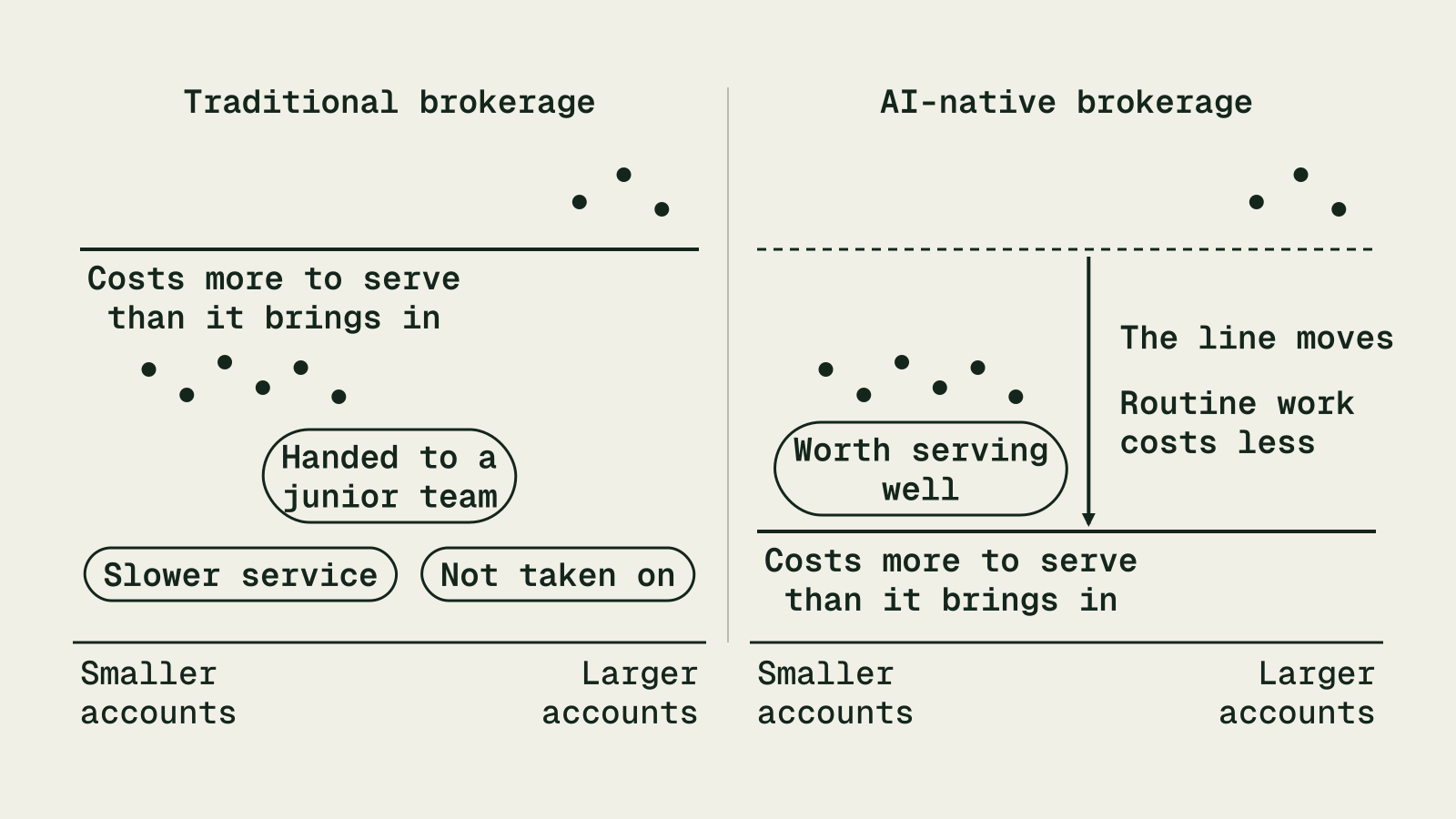
So most brokerages have a line, written down or not, below which an account costs more to serve than it brings in. Accounts under that line get slower service, get handed to a junior team, or are not taken on at all.
An AI-native brokerage moves that line. When the routine part of each placement and renewal costs far less than it did, a small account no longer has to subsidize the broker's time. It can get careful review like a larger client's, because the broker's time goes only to the parts that need a broker. That is a larger shift than saving staff hours: it changes which clients the business can afford to take on.
How is it different from a brokerage that adds AI tools?
We cover the general difference between AI-native and AI-enabled in What is an AI-native services company?. In brokerage, it shows up in what happens after a broker steps in.
In a brokerage that has added AI tools, a broker fixes a wrong answer on an application, and the fix stays in that one file. Next year, the same mistake can come back.
In an AI-native brokerage, every judgment a broker makes is captured with its reason and built back in. If a broker overrides how a certain kind of business was described to insurers, or why one quote beat another, that decision shapes the next file of the same kind. Over time, each renewal and each new account of a familiar type needs less of a broker's time than the last. We describe that loop in How does a data flywheel make each job cheaper in AI-native services?.
What should buyers and investors watch for?
For a business buying coverage, the useful questions are practical:
- Who do you talk to when you need advice, and how quickly do you reach them?
- How fast do routine requests, such as certificates and policy changes, come back?
- Does someone actually review your coverage at renewal, or does it roll over unchanged?
For an investor, the question is whether the cost to serve keeps falling. A brokerage that bought software once gets cheaper once, and then the cost goes flat. One that is AI-native should show broker time per policy falling year after year, and should be able to serve well the accounts other brokerages pass over.
Questions people ask
Is an AI-native brokerage the same as buying insurance online?
No. Buying direct online usually means taking one insurer's policy through a form. An AI-native brokerage still compares several insurers and gives advice from a broker; AI handles the paperwork behind that advice.
How does an AI-native insurance brokerage make money?
The same way other brokerages do, mostly through a share of the premium on the coverage it places, sometimes with fees. The difference is cost: each account takes less broker time to serve, so more of that revenue stays in the business.
Do clients still deal with a broker?
Yes. A broker handles advice, coverage choices, negotiation with insurers and disputed claims. Routine requests can come back faster because a system prepares them.
What kind of insurance suits an AI-native brokerage best?
Lines with document-heavy, repeat work and many similar clients, such as standard commercial coverage for smaller businesses. Large, unusual risks lean more heavily on a broker's judgment, though AI still prepares the file.
Questions or ideas? Email hello@skywakelabs.com.
Buyers, investors and partners: hello@skywakelabs.com
More notes
What is agentic BPO?
Outsourcing where AI agents work most cases and specialists take the exceptions. Real agentic BPO prices the finished case, not seats or agents.
ReadWill AI replace procurement teams?
Not the team. AI takes the paperwork of buying; people keep the decisions with no written answer: which supplier, on what terms and whether to buy at all.
Read