Is AI getting cheaper to run?
Per unit of capability, yes. Per finished task, not by default: tasks use more AI, and in our view people time is the bigger cost.
Per unit of capability, yes: the price of getting a given quality of answer from an AI model keeps dropping. Per finished task, not by default, because teams spend cheaper models on harder and longer work, and in our view the larger cost in most back-office work is still the people time spent checking and finishing what the AI produces. The cost of a finished job falls only when the work is designed to need less of that time.
Why does the price of AI keep dropping?
Model providers compete hard on price, and each generation of models and chips gets more done for the same spend. Quality that once cost a premium is soon offered for less, often by several providers.
For anyone running AI, that is a real gain. Reading an invoice, pulling the fields from a claim form or summarizing a case file costs far less to run than it did when those tasks first became practical.
But that price is quoted per unit of model output, and no business buys units of model output. It buys a paid invoice, a settled claim, a closed month. The question worth asking is what happens to the cost of those.
Why doesn't a cheaper model make each task cheaper?
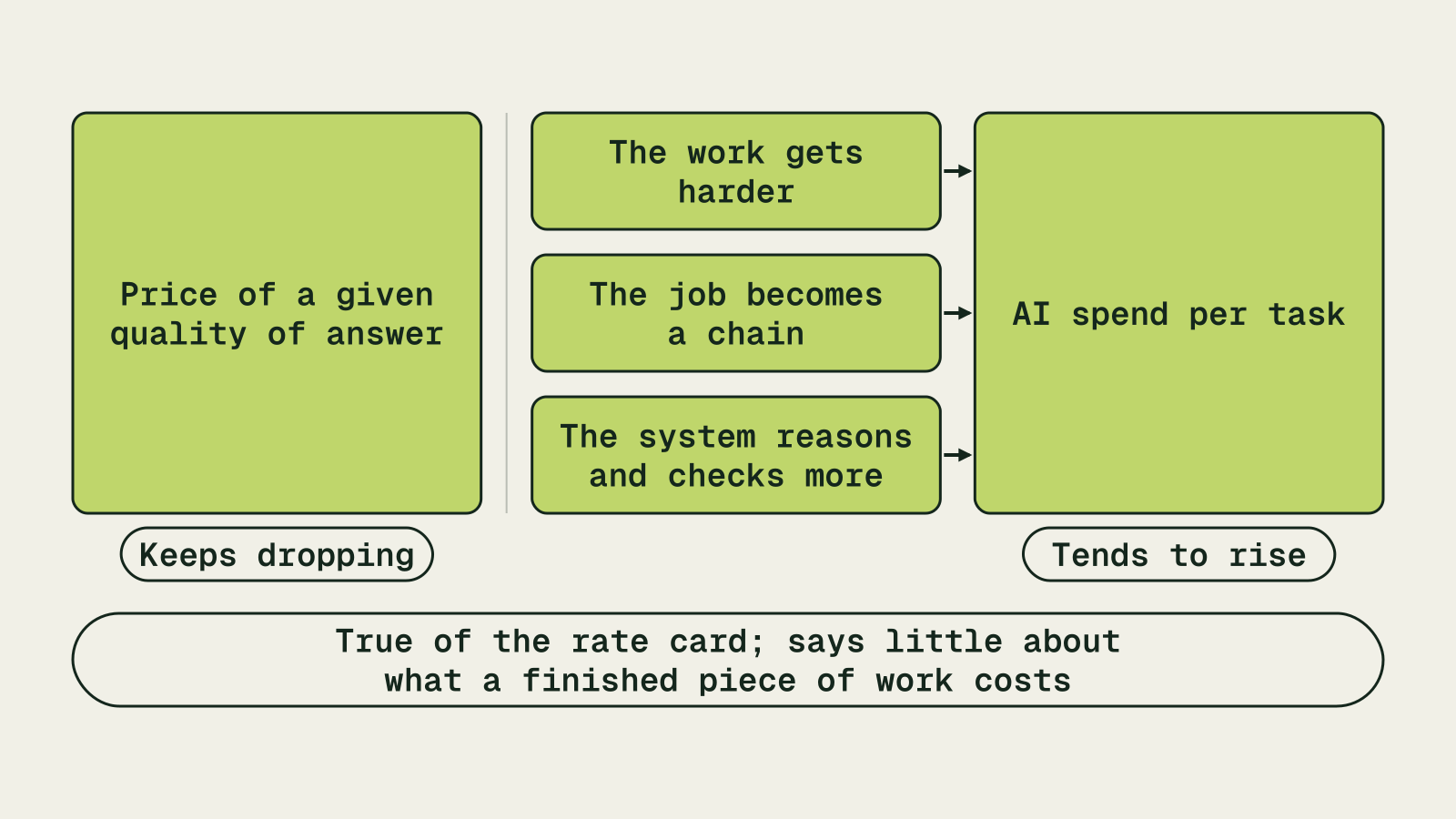
Because each task tends to use more AI over time, not less. Three forces push the same way:
- The work gets harder. Once AI is cheap enough, teams give it the cases they would not have trusted it with before: the claim with missing documents, not the clean one. Harder cases take more work to get right.
- The job becomes a chain. What started as one question turns into a sequence: read the claim, find the policy, compare the two, flag what does not fit, draft the note for the specialist. Every link is another run of the model, and every run is paid for.
- The system reasons and checks more. Newer models can reason through a problem step by step, and well-built systems test their own output and redo what fails. Both raise quality, and both add to the cost of the task.
On top of that, the most capable setups often cost more per task than the ones they replace, even when their list price is lower. A team that always moves to the newest model can watch its spend per task climb while older levels of quality become cheap.
None of this is waste. It is the cost of the AI doing more of the job. It does mean that "AI keeps getting cheaper" is true of the rate card and says little about what a finished piece of work costs.
Where does most of the cost of a finished job sit?
In our view, for back-office work such as invoices and claims, the model is seldom the expensive part. The larger share is people: the time someone spends reviewing the output, fixing what is wrong, finishing the cases the system handed back and catching the ones it should have handed back but did not.
That changes what cheaper models are worth. Making a small line cheaper barely moves the total. Cutting the minutes a specialist spends on each claim moves it a great deal. How to count that full cost is covered in How should buyers evaluate AI agents?
Should a business count on AI getting cheaper?
We would not. A business should make money on the work at today's prices and treat every price cut as upside, for three reasons.
- Ambition eats the savings. As shown above, the AI used per task tends to rise as the work it is trusted with grows.
- Prices move both ways. Providers set their own prices and terms, and a plan that only works if they keep falling is a bet on someone else's decisions.
- The savings are shared. A public price cut reaches every competitor at once, so in a market where several sellers deliver the same work, buyers soon expect it back in lower prices. We make the wider version of this point in How does a data flywheel make each job cheaper in AI-native services?
For investors, this is the weak spot in a plan whose margins widen mainly because model prices are expected to fall. That gain is not specific to the company. It belongs to the market.
What should buyers and investors watch instead?
Split the cost of a finished job into two lines and follow each over time.
- AI spend per finished job. This moves with the market and with how much AI each job uses. Expect it to go down when prices fall and up when harder work or a stronger model goes in.
- People time per finished job. This moves with how the work is run. When every judgment a specialist makes is captured with its reason and built back in, this line falls job after job. When it is not, the line stays flat, whatever model prices do.
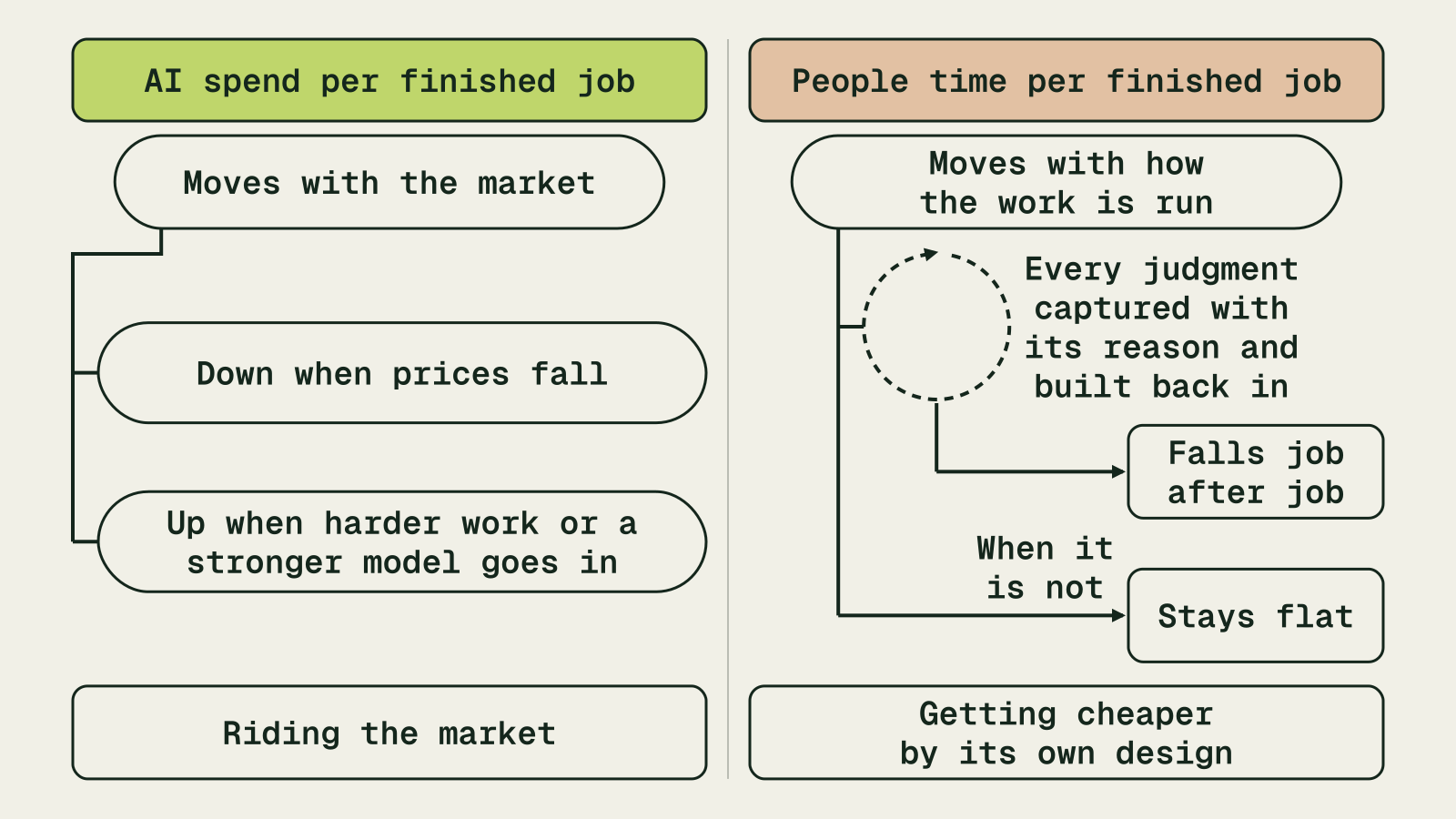
A company whose total cost falls only when the first line falls is riding the market. A company whose second line keeps falling is getting cheaper by its own design. We judge a business by how fast the work gets cheaper, and the second line is where that shows.
Questions people ask
Is AI getting more expensive?
The price of a given level of quality keeps falling. What can rise is spend per task, because the most capable models often cost more per task and teams hand AI longer, harder work. Both can be true at the same time.
Will AI get cheaper in the future?
In our view, the price of a given capability is likely to keep falling as providers compete and hardware improves. Whether a company's cost per finished job falls is a separate question. It depends more on how the work is designed than on what models cost.
Is AI cheaper than human labor?
For a routine step with a result that can be checked, running AI often costs less than a person's time on the same step. The fair comparison is the whole finished job, including the time people spend reviewing and completing what the AI produced.
Why does an AI agent cost more to run than a single AI answer?
A single answer is one run of the model. An agent works through a job as a series of steps, each one a run of its own, often with checks and retries along the way. The series costs more, and it earns that cost only if the job ends up finished.
Questions or ideas? Email hello@skywakelabs.com.
Buyers, investors and partners: hello@skywakelabs.com
More notes
What is agentic BPO?
Outsourcing where AI agents work most cases and specialists take the exceptions. Real agentic BPO prices the finished case, not seats or agents.
ReadWill AI replace procurement teams?
Not the team. AI takes the paperwork of buying; people keep the decisions with no written answer: which supplier, on what terms and whether to buy at all.
Read